

Website Cost in Korea: 2026 Prices in USD
Websites USD 1,900–4,300, landing pages from USD 550, web apps USD 1,800–3,900, custom ERP from USD 10,500, excl. VAT. Every price line we publish.
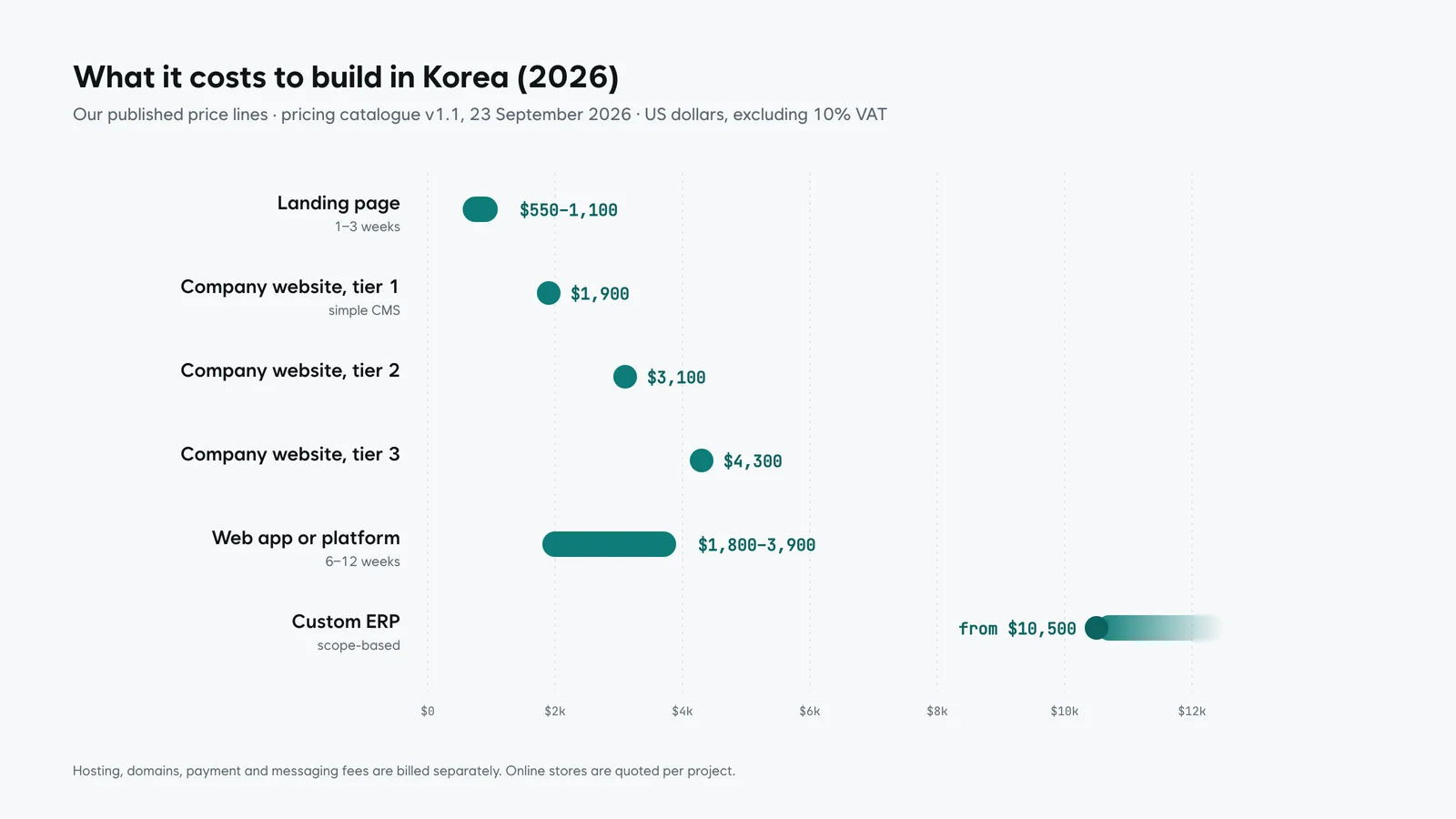
In our pricing catalogue (version 1.1, 23 September 2026), a website built in Korea costs USD 1,900, 3,100 or 4,300 depending on the tier, a one-page landing page USD 550–1,100, a web app USD 1,800–3,900 and a custom ERP from USD 10,500, all excluding 10% VAT. Hosting, domains and payment or messaging fees are billed separately. This page lists every price line we publish, what moves a project up or down the range, and how payment works for a company outside Korea.
How much does a website cost in Korea in 2026?
These are our own prices, not a market survey. They are what we quote from, in US dollars, excluding VAT.
| What you are building | Price (USD, excl. VAT) | Typical build time |
|---|---|---|
| One-page landing page that collects inquiries or sign-ups | 550–1,100 | 1–3 weeks |
| Company website, three tiers (the first is a simple CMS build) | 1,900 / 3,100 / 4,300 | Agreed in the quote |
| Web app or platform with sign-in, core flows and admin | 1,800–3,900 | 6–12 weeks |
| Online store | Quoted per project (store and payment modules below) | Agreed in the quote |
| Custom ERP | From 10,500 | Agreed in the quote |
We can invoice in US dollars or take payment by overseas transfer.
What does each add-on cost?
Most projects are a base build plus a few modules. These are the module lines from the same catalogue:
| Module | Price (USD, excl. VAT) | Third-party costs |
|---|---|---|
| A second language (each further language USD 150–300) | 200–550 | — |
| Extra page beyond the tier (each) | 50–150 | — |
| Design upgrade (more directions, motion) | 300–850 | — |
| Product catalogue | 700–1,400 | — |
| Detailed inquiry or order form (files, status) | 450–1,100 | — |
| Social login (Kakao, Naver) | 200–550 | — |
| Phone identity verification | 450–850 | Verification provider fees |
| One-time payments | 550–1,300 | Payment fees |
| Recurring (subscription) payments | 1,400–2,900 | Payment fees |
| Online store module (needs a payment module) | 1,400–3,600 | Payment fees |
| KakaoTalk AlimTalk and SMS notifications | 200–550 | Sending fees |
| Extended admin (three or more roles, Excel export, audit log) | 450–1,100 | — |
| Advanced SEO and GEO | 350–1,100 | — |
| Data migration from an old site or spreadsheets | 350–1,100 | — |
| Discovery before the build | 200–550 | — |
Have a budget but no brief yet? Write to us in two minutes. No brief or files needed; tell us what you want to build and roughly what you can spend, and we will reply with the scope we would suggest.
What moves a project up or down the range?
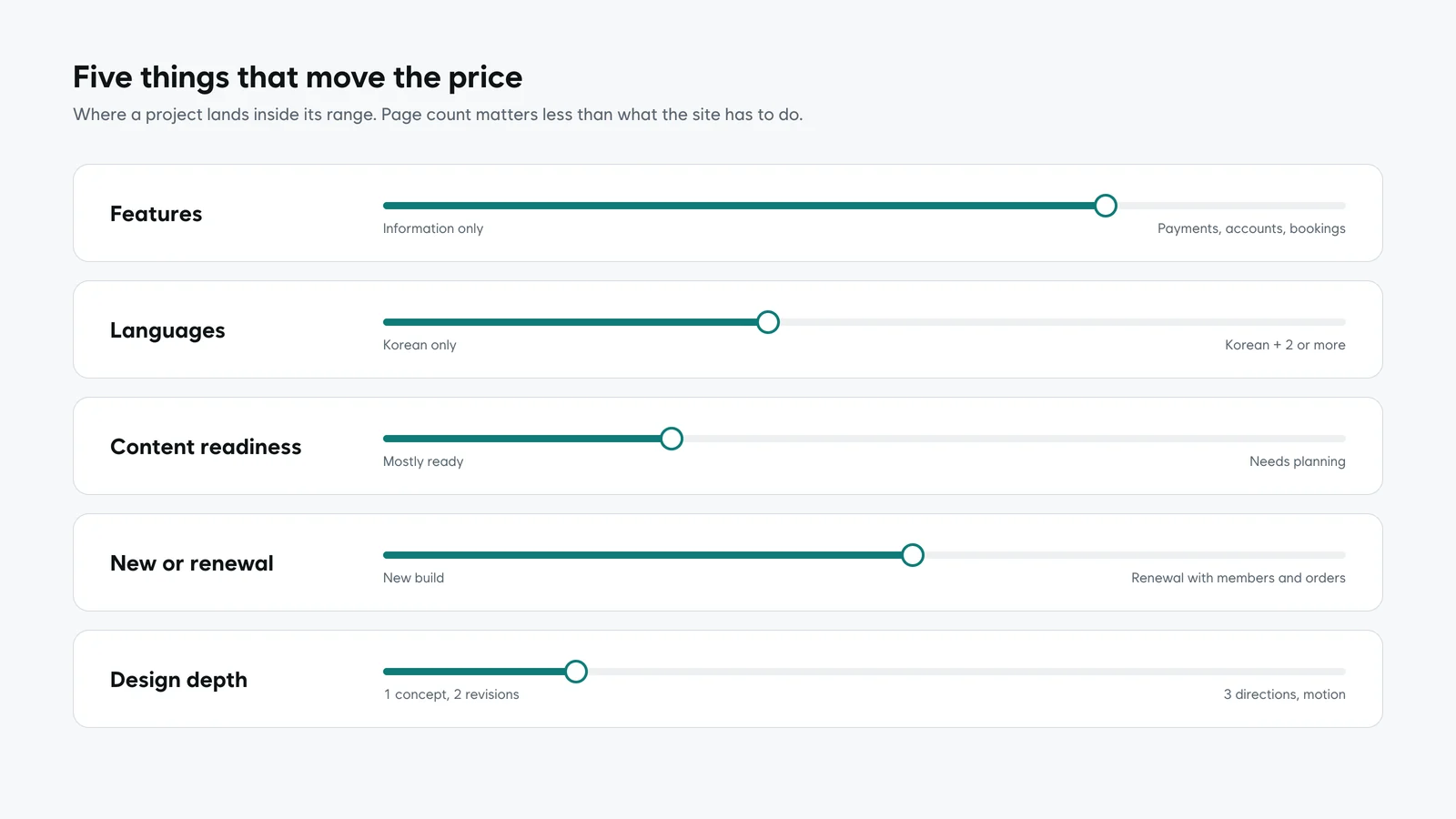
We quote by the features a site needs rather than by page count. In practice, five things decide where a project lands:
- What the site has to do. Showing information is the cheapest. Payments, accounts, bookings, phone verification and Korean integrations add development and testing.
- How many languages, and who writes them. Our prices assume you provide the translations. A second language is a module, not a rebuild.
- How ready the content is. Content that is mostly ready keeps a project at the low end. Content that still needs planning adds discovery time.
- New build or renewal. Renewing an existing site often means moving posts, images, members or orders. Data migration is priced as a module.
- Design depth. Our standard design is one concept with two rounds of revisions. More directions or motion is the design upgrade module.
What is not included in the build price?
Every quote from us lists these separately, so they never appear as surprises:
- VAT at 10%.
- Hosting. Hosting and maintenance are a separate contract from the build, with their own terms.
- Domain fees.
- Usage fees passed through at cost: payment gateway fees, SMS and KakaoTalk message fees, AI API usage and app store accounts.
How is payment split?
Payment is made in instalments tied to checkpoints, with the split written into the contract: 70/30, 40/30/30 or 40/20/20/20 depending on the size of the project. Each instalment follows a checkpoint you can see, such as an interim build or final acceptance. For a company outside Korea, we bill in US dollars or by overseas transfer.
How do our prices compare with other options?
A quote from another studio is only comparable if it covers the same things. When you put two quotes side by side, check that each one states:
- the feature list, not just a page count
- how many design concepts and revision rounds are included
- whether there is an admin (CMS) you can edit yourself, and what it can edit
- how hosting, maintenance and third-party fees are handled
- the payment schedule and what each instalment pays for
- how the source code and other deliverables are handed over
Our guide to hiring a developer in Korea has a one-page brief you can send to several studios, so the quotes you get back can actually be compared.
Who builds it, and how do you start?
We are a two-person studio in Korea; our CEO and a director design and build each project themselves. Our English-speaking founder runs consultations, meetings and documents directly, and we can meet you in person in Korea. Bilingual work we can show includes the Korean–English website for EMECS and the Korean–English platform for UNESCO i-WSSM, which is in operation.
See what we build on the web development in Korea page, or the ERP development in Korea page if you are budgeting an internal system.
Frequently asked questions
How much does a website cost in South Korea?
In our pricing catalogue (version 1.1, 23 September 2026), a company website costs USD 1,900, 3,100 or 4,300 depending on the tier, and a one-page landing page USD 550–1,100, excluding 10% VAT. Hosting, domains and third-party fees are separate.
How much does a web app cost to build in Korea?
A web app with sign-in, core flows and an admin is USD 1,800–3,900 in our catalogue, over 6–12 weeks, excluding VAT. Payments, Korean login, notifications and other modules are added on top.
How much does a custom ERP cost in Korea?
Our custom ERP builds start from USD 10,500, excluding VAT. The final price depends on the workflows, integrations and data migration. Our custom ERP cost guide has the detail.
Is VAT included in Korean website quotes?
Korean quotes are normally written excluding VAT, which is 10%. Ours are too. How VAT applies to a client outside Korea is a question for your accountant.
Can I pay a Korean developer in US dollars?
We can invoice in US dollars or take payment by overseas transfer. The build is paid in instalments tied to checkpoints written into the contract.
Sources
- NQ Solution pricing catalogue v1.1 (23 September 2026), in USD excluding VAT; custom ERP pricing updated in 2026
- NQ Solution English estimator, /en/estimate, cost notes checked in 2026
Get a price for your project
The fastest way is to write to us in two minutes: no brief or files needed. If you already have a brief, wireframes or a reference site, send it with the project request form (up to three files, 10 MB each). To outline the scope yourself first, use our estimator, which walks through pages, languages, features and delivery and gives an estimated timeline.