

How to Hire a Developer in Korea: 1-Page Brief
Send every Korean studio the same one-page brief, then compare quotes line by line, not on the total. The brief, the questions to ask, a quote checklist.
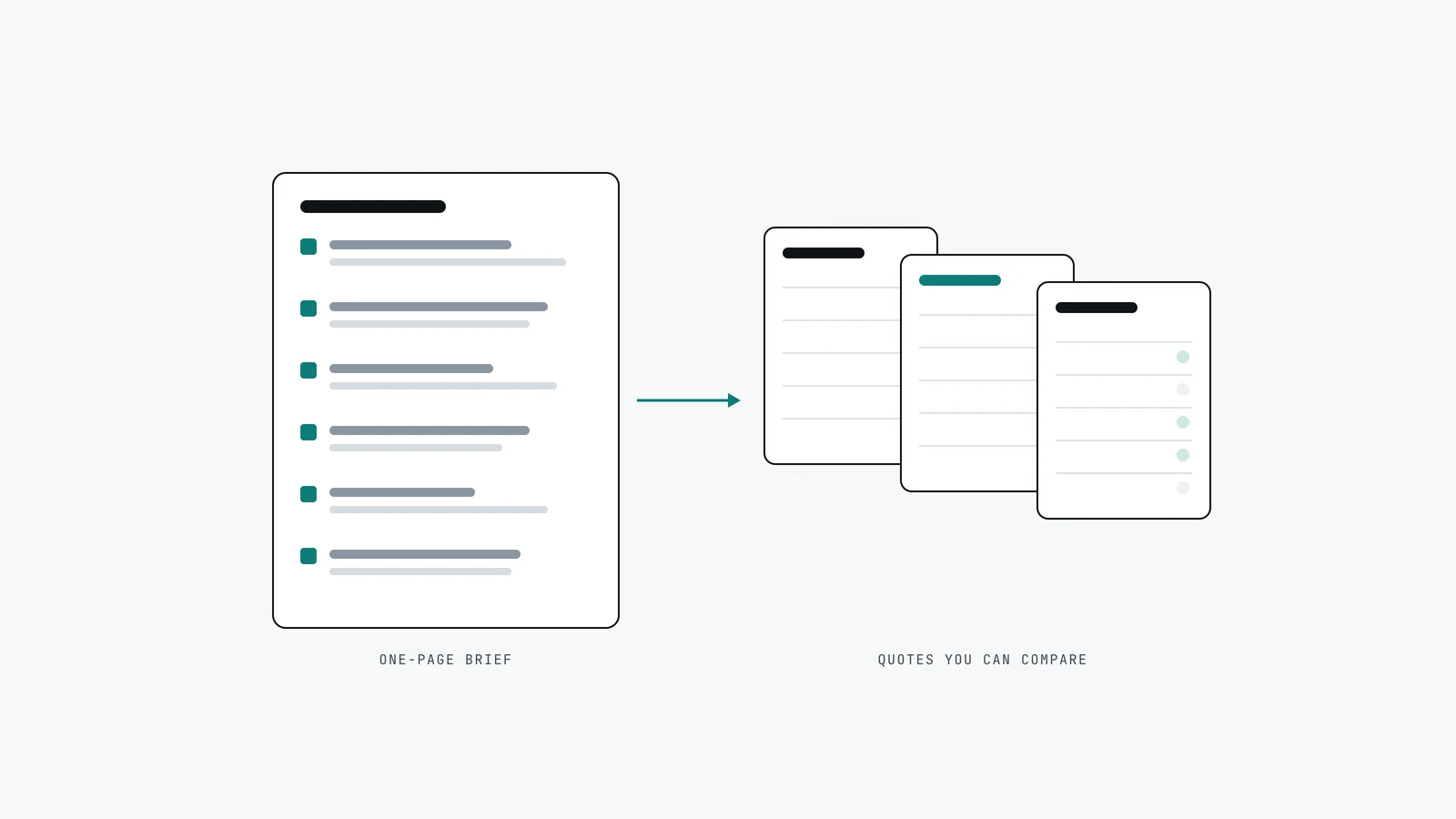
To hire a developer in Korea without wasting weeks, send every studio the same one-page brief: who the product is for, the five to ten things it must do, the Korean services it needs (payments, KakaoTalk, Naver), your budget range and your launch date. Then compare the quotes line by line on scope, design rounds, admin, hosting, payment schedule and source code handover, not on the total. This guide gives you the brief, the questions to ask and a checklist for comparing quotes.
Should you hire a freelancer, a studio or an agency in Korea?
| Option | Fits when | What to check |
|---|---|---|
| Freelancer | A small, well-defined job, and you can manage the work yourself | Who covers design, testing and the Korean applications; what happens if they become unavailable |
| Small studio | A website, web app or internal system with a clear feature list | Who you talk to day to day, how many projects they take at once, how they work in English |
| Larger agency | A big programme with many parallel workstreams, or a brand and marketing mandate on top of the build | Who actually builds it, and how changes are priced |
| Dedicated developers (monthly) | Long-running product work with your own product manager | Notice periods, replacement terms, who owns the code |
Most foreign companies we talk to need a defined product built for Korean users, which is what fixed-scope projects with a studio are designed for. Our guide to outsourcing software development to South Korea covers Korean contract norms and time zones in more depth.
What should a one-page brief for a Korean developer include?
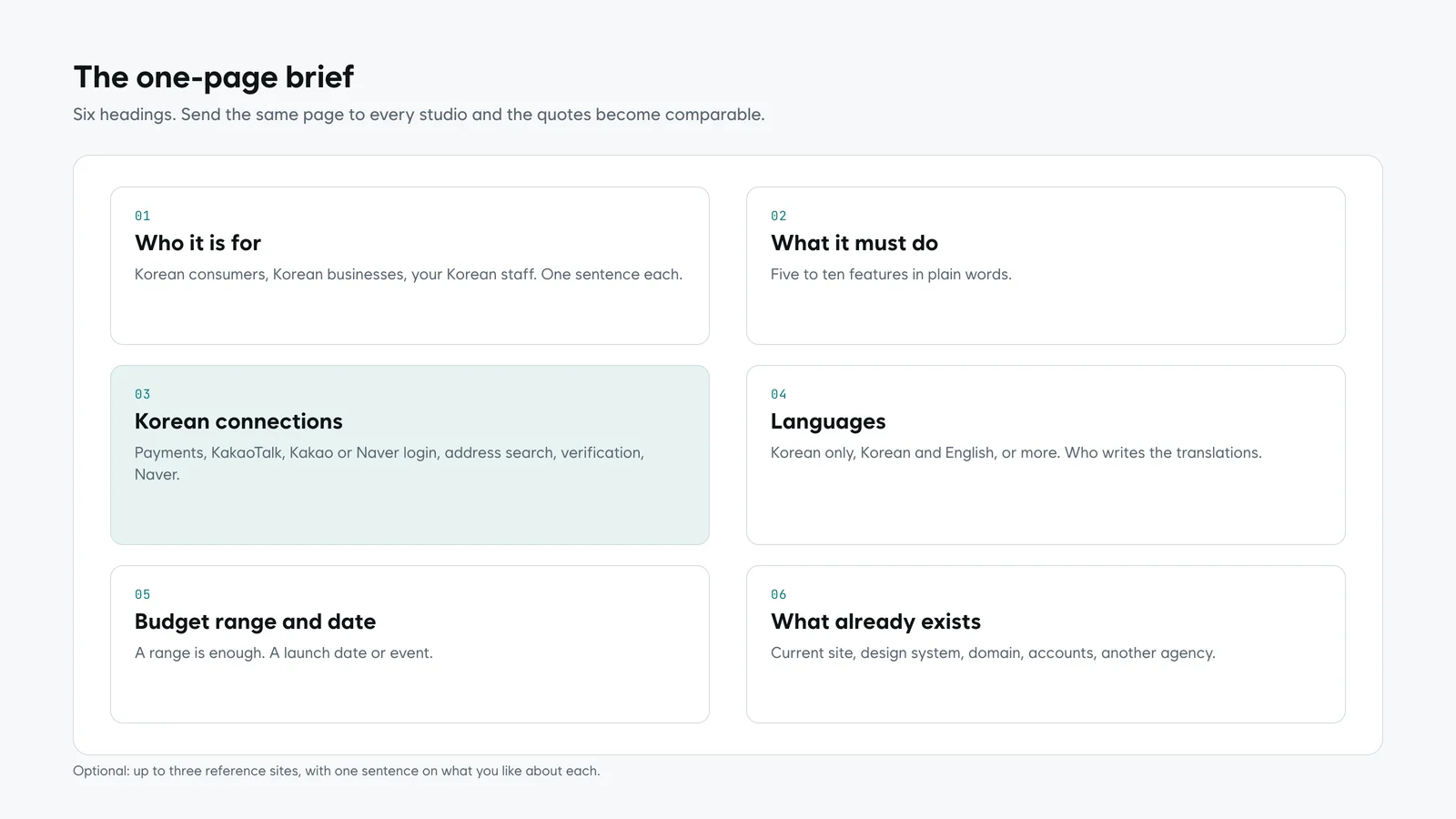
You do not need a specification document. One page with these six parts is enough for a studio to quote:
- Who it is for. Korean consumers, Korean businesses, your Korean staff, or a mix. One sentence each.
- What it must do. Five to ten features in plain words: "visitors request a quote with files", "members pay a monthly subscription", "head office sees orders in English".
- What it connects to in Korea. Payments (a Korean PG, Stripe, or not yet decided), KakaoTalk notifications, Kakao or Naver login, address search, phone verification, Naver Search Advisor. If you are not sure, say so.
- Languages. Korean only, Korean and English, or more, and who writes the translations.
- Budget range and launch date. A range is enough. Without one, studios guess, and the quotes will not be comparable.
- What already exists. A current site, a design system, a domain, accounts with Korean services, or a global agency that keeps part of the work.
Add up to three reference sites and one sentence on what you like about each.
Prefer to skip the brief? Write to us in two minutes: a few lines on what you want to build is enough, and we will ask the questions that matter for the quote.
Fixed price or time and materials?
| Fixed price (fixed scope) | Time and materials | |
|---|---|---|
| How the price is set | A quote per feature, paid in instalments | Hours or person-days, billed monthly |
| Who carries the risk | The studio, for the agreed scope | You, for the total |
| Works best for | A product with a clear feature list | Research, unclear scope, ongoing product work |
| Changes | A change request with its own estimate | Absorbed into the monthly hours |
| What you need on your side | A clear feature list and someone to approve checkpoints | A product owner who manages priorities every week |
We work on fixed-scope projects. The quote items become the contract scope, and payment is split into instalments tied to checkpoints: 70/30, 40/30/30 or 40/20/20/20 depending on the size of the project. Anything outside the feature list is a written change request with its own estimate before work starts.
How do you compare quotes from Korean studios?
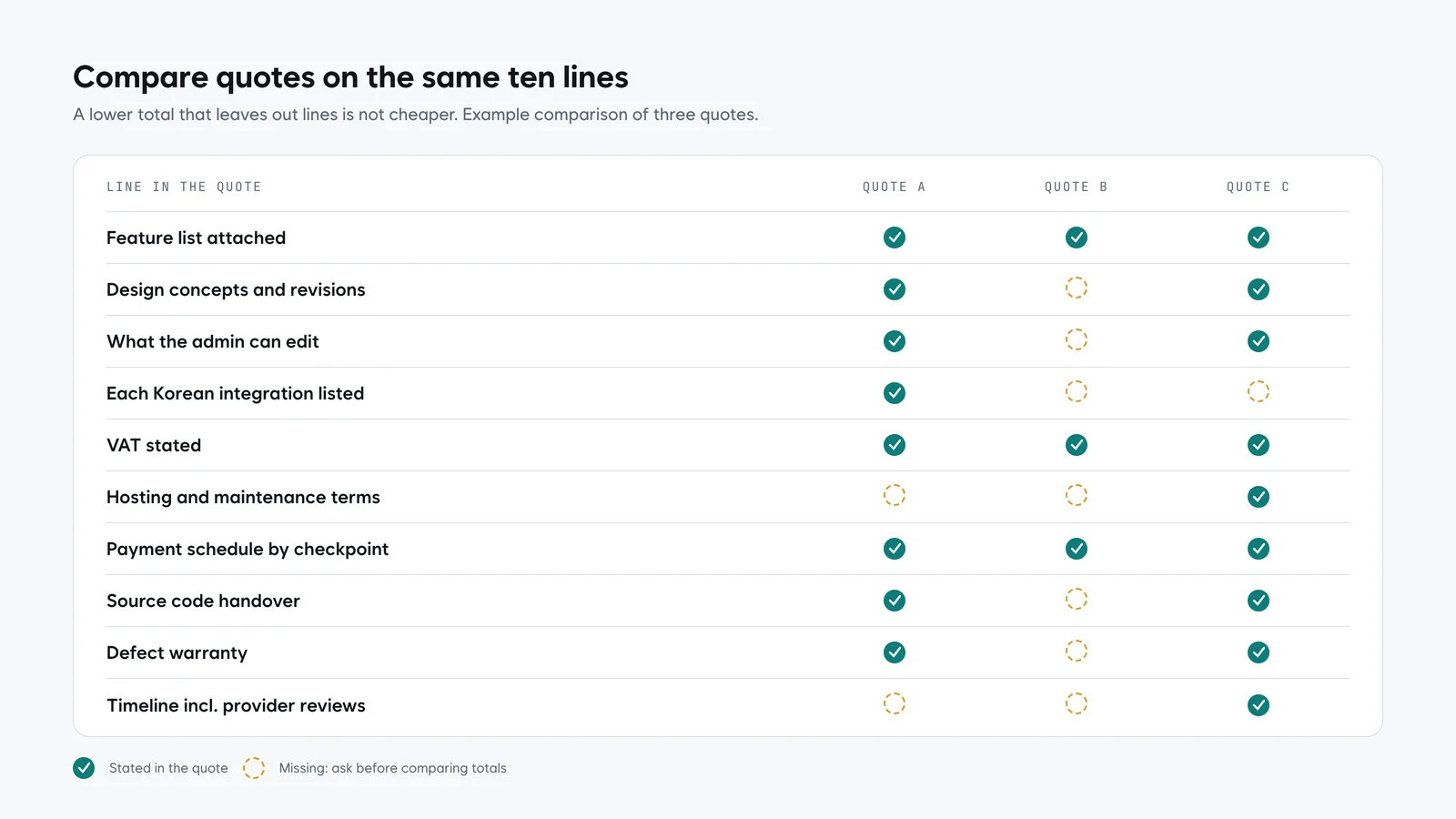
Put the quotes in one table and check the same lines in each. A lower total that leaves out three of these lines is not cheaper.
| Line | What to look for |
|---|---|
| Scope | The feature list is attached, not just "10 pages" |
| Design | Number of concepts and revision rounds |
| Admin (CMS) | What you can edit yourself, and how many admin accounts |
| Korean integrations | Each one listed separately, with third-party fees passed through at cost |
| VAT | Korean quotes are normally written excluding 10% VAT |
| Hosting and maintenance | Included, or a separate contract, and on what terms |
| Payment schedule | Instalments tied to checkpoints you can verify |
| Source code and deliverables | How and when they are handed over, written into the contract |
| Defect warranty | How long, and how defects are told apart from new requests |
| Timeline | Build time, plus the reviews that run on the providers' schedules (PG, Kakao, Naver) |
What should you ask in the first call?
- Who will we talk to every week, and does that person also build the product?
- Can the project run in English: calls, documents, the admin, invoices?
- Which Korean applications will you prepare (payment gateway, KakaoTalk Channel, Naver Search Advisor), and in whose name will they be?
- What do you need from us, and by when, so the schedule holds?
- How do you show progress between checkpoints?
- What happens after launch: hosting, fixes, small changes?
What does hiring a Korean studio cost?
From our pricing catalogue (version 1.1), excluding 10% VAT: a company website USD 1,900, 3,100 or 4,300 depending on the tier, a web app USD 1,800–3,900, and a custom ERP from USD 10,500. Every module and what is billed separately is listed in website development cost in Korea.
How we take on new projects
We are a two-person studio in Korea; our CEO and a director design and build each project themselves, and to protect quality we adjust how much work we take on at once. If our schedule is full, we tell you when we can start during the first conversation. Our English-speaking founder runs consultations, meetings and documents directly, and we can meet you in person in Korea. We bill in US dollars or by overseas transfer.
On the Korean side, we prepare the applications and handle the Korean-language communication for payment gateways, the KakaoTalk Channel and Naver Search Advisor, while your company stays the contracting party. See what we build on web development in Korea and software development in Korea.
Frequently asked questions
How do I hire a web developer in South Korea?
Send the same one-page brief to two or three studios: who the product is for, five to ten features, the Korean services it needs, languages, budget range and launch date. Compare the quotes line by line on scope, design rounds, admin, hosting, payment schedule and handover.
Do Korean developers work in English?
Some do. Ask who your day-to-day contact will be and whether that person also builds the product. At our studio, our English-speaking founder runs consultations, meetings and documents directly.
Should I choose fixed price or time and materials?
Fixed price suits a product with a clear feature list, because the studio carries the risk for the agreed scope. Time and materials suits research or ongoing product work where scope changes every week and you have someone to manage it.
What should a quote from a Korean studio include?
The feature list, design rounds, what the admin can edit, each Korean integration, VAT, hosting and maintenance terms, the payment schedule, how source code is handed over, the defect warranty and the timeline.
Can a Korean studio sign the payment gateway contract for us?
The contract should stay in your company's name. A studio can prepare the application and handle the Korean-language communication with the provider, which is what we do.
Sources
- NQ Solution pricing catalogue v1.1, in USD excluding VAT; custom ERP pricing updated in 2026
- NQ Solution contract templates: instalment splits and written change requests
Ready to brief us?
Write to us in two minutes with a few lines on what you want to build: no brief needed. If you already have the one-page brief, wireframes or files, send them with the project request form. To outline the scope yourself first, try the estimator, or start from the Korea market entry overview.