Launching a SaaS in Korea: 5-Layer Checklist
Korean UI, Kakao or Naver sign-in, billing with Korean cards and wallets, KakaoTalk support and the legal pieces. Start with the UI and billing.
To launch a SaaS product in Korea, localize five layers, not just the marketing site: the product interface in Korean, sign-up and sign-in (often with Kakao or Naver), billing that accepts Korean cards and wallets, notifications and support through KakaoTalk, and the legal pieces: a Korean privacy policy, marketing consent and, for consumer sales, VAT registration. Start with the Korean interface and billing, because those decide whether a Korean team can buy at all.
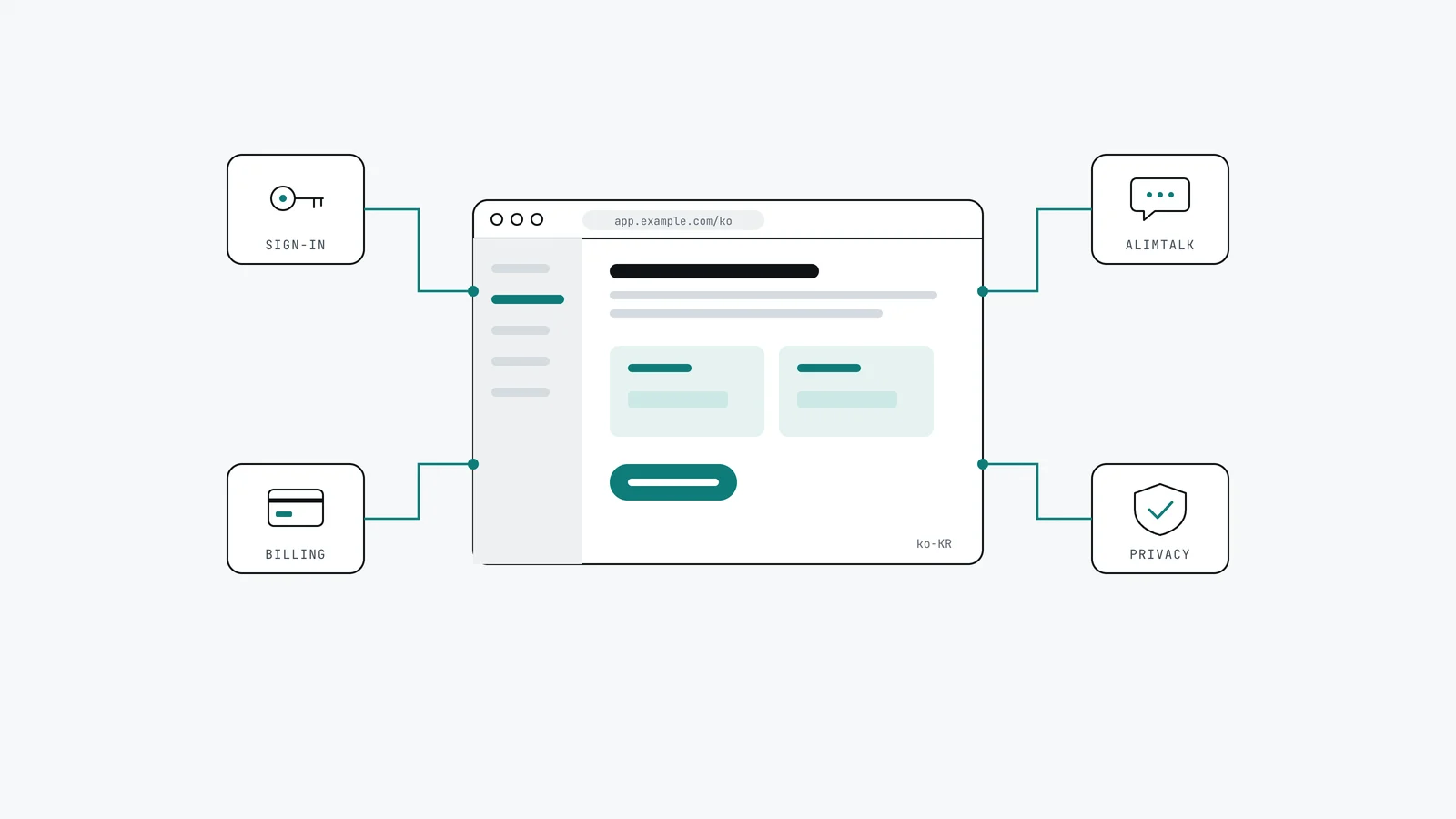
This checklist is for SaaS teams outside Korea planning Korean customers. Each section links to a deeper guide where we have one.
What changes in the product, not just the website?
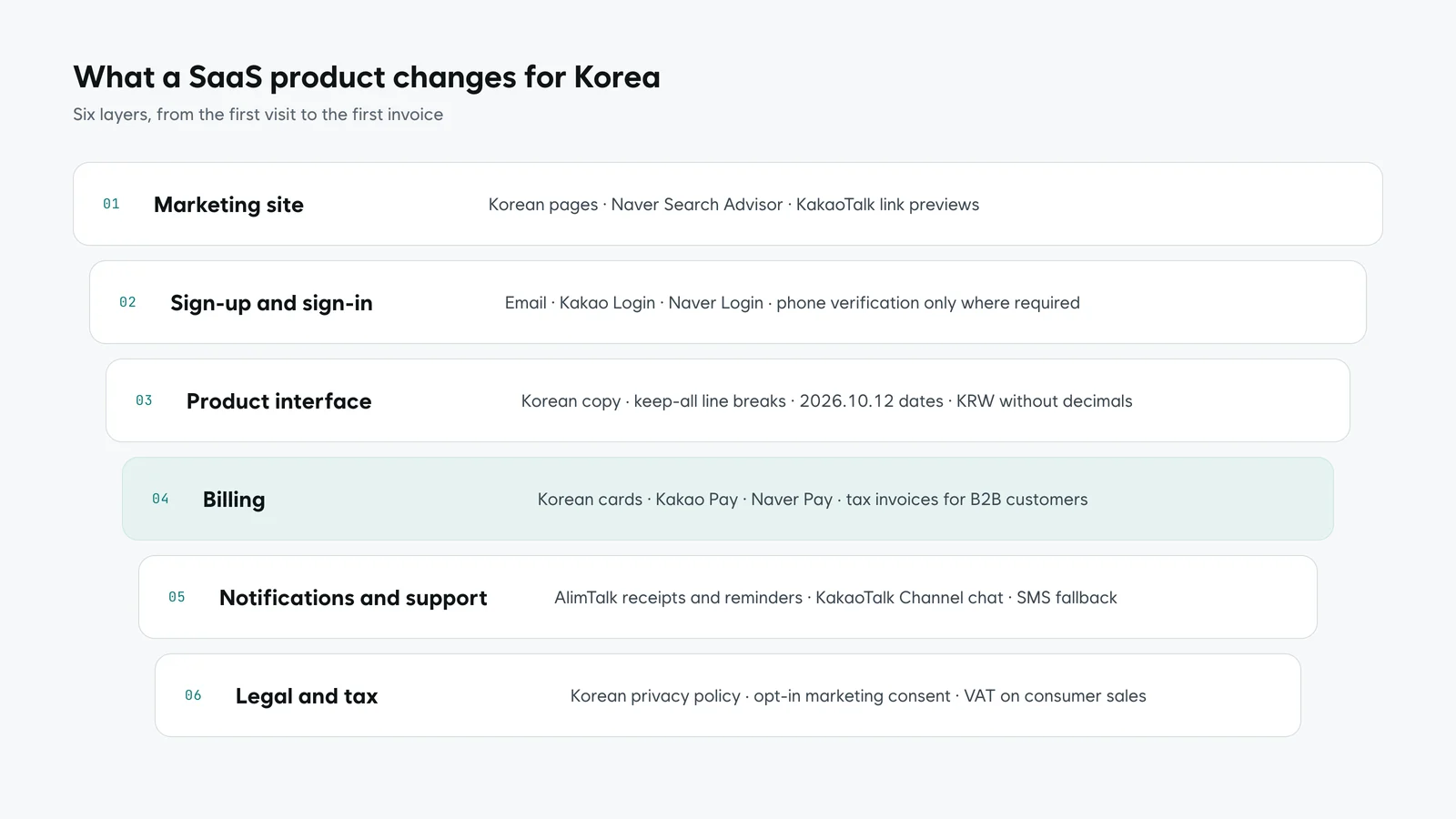
A translated landing page brings Korean visitors to a product that may still feel foreign once they sign up. These are the areas that change:
| Layer | What Korean users expect | Read more |
|---|---|---|
| Interface | Korean text that reads naturally, Korean date and number formats, fonts that render Hangul well | Korean web design |
| Sign-up and sign-in | Email works; Kakao Login and Naver Login are common one-tap options | Kakao and Naver login |
| Billing | Korean credit and check cards, Kakao Pay, Naver Pay; prices in won | Stripe in Korea, Korean payment gateways |
| Notifications | KakaoTalk messages (AlimTalk) for receipts, reminders and alerts | KakaoTalk Channel and AlimTalk |
| Support | A KakaoTalk Channel for chat, Korean help pages | Same guide |
| Forms | Address search instead of free-text address fields, Korean phone formats | Korean address search API |
| Legal and tax | Korean privacy policy, opt-in marketing consent, VAT on consumer sales | Below |
| Discovery | A Korean marketing site that Naver and Google can read | Naver SEO |
What does a Korean interface need beyond translation?
Translation is the visible part. The details that make a product feel built for Korea are smaller:
- Line breaking. Korean wraps between syllables by default, which can split words across lines. Setting
word-break: keep-allon Korean text keeps words together. - Dates and numbers. Korean users read dates year first (2026.03.15 or 2026년 3월 15일). The won has no minor unit, so show prices without decimals.
- Names and phone numbers. A single name field written family name first works better than first and last name boxes. Mobile numbers look like 010-1234-5678.
- Tone. Product copy in Korean is usually polite and fairly formal. Pick one level of politeness and keep buttons, errors and emails consistent with it.
- Text length. Korean strings are often shorter than English, but not always. Test every screen with real Korean text instead of assuming the English layout will hold.
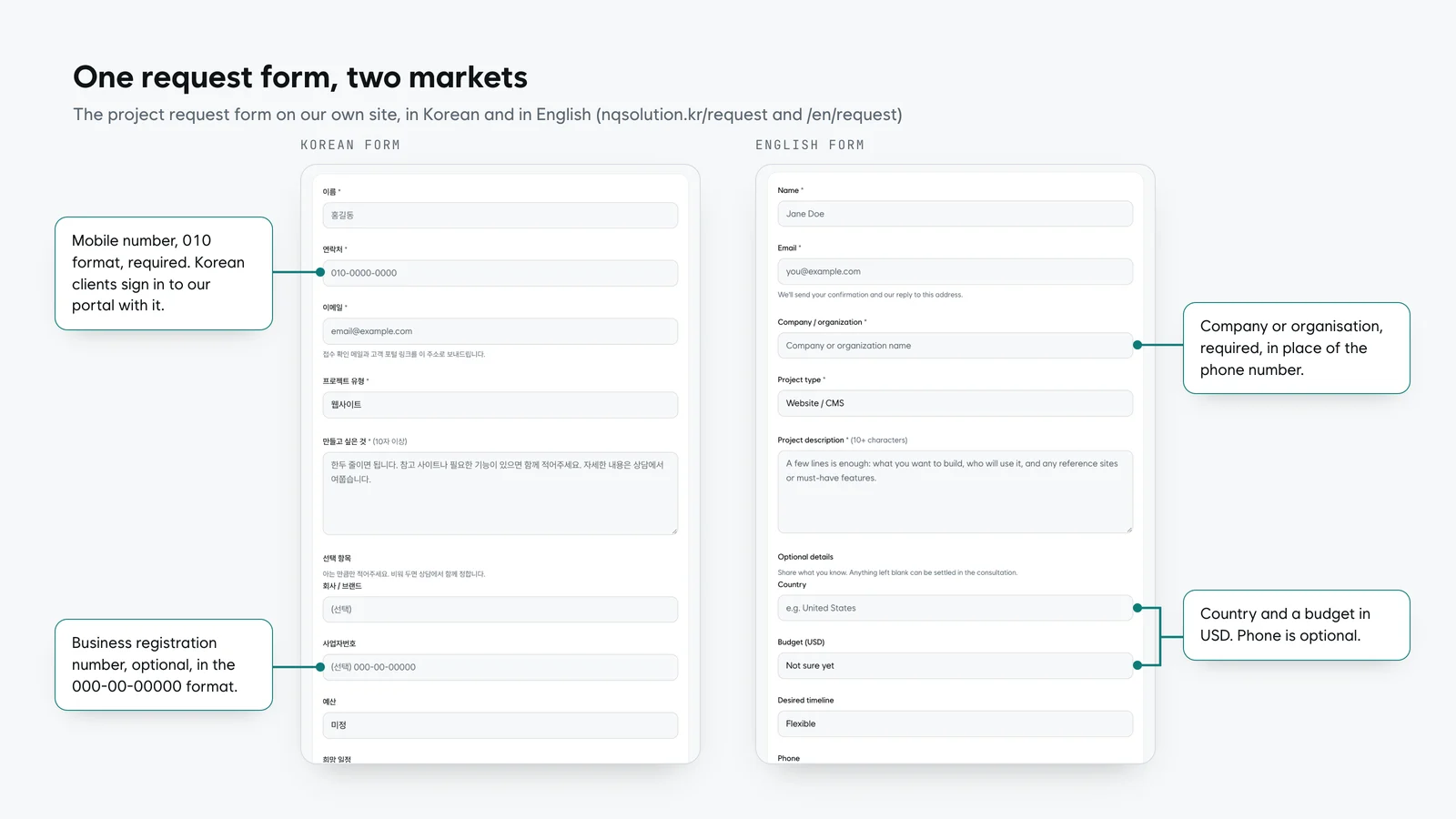
The quickest way to see the difference is to compare one form in both languages. On our own site, the Korean request form requires a mobile number in the 010 format, which Korean clients use to sign in to our client portal, and offers a field for a business registration number. The English form requires a company name instead, asks for the country and takes a budget in US dollars.
How do Korean customers pay for a subscription?
There are three routes, and the deciding question is whether you have a Korean entity.
| Route | What it covers | Works when | Trade-off |
|---|---|---|---|
| Stripe from your existing entity | Korean cards, plus wallets such as Kakao Pay and Naver Pay; Stripe documents subscriptions on Korean cards | Your company is in a country Stripe supports | Your customer must authorise the card for future payments first; check which methods support recurring charges |
| A merchant of record such as Paddle | The provider sells to the customer and handles tax; Paddle added recurring KakaoPay and Naver Pay in November 2025 | You want tax handling included and accept the provider's fees and checkout | Less control over the checkout and the customer relationship |
| A Korean payment gateway with recurring billing | Domestic cards and wallets, settled in won in Korea | You have a Korean entity or branch | Korean documents and a separate review for recurring billing |
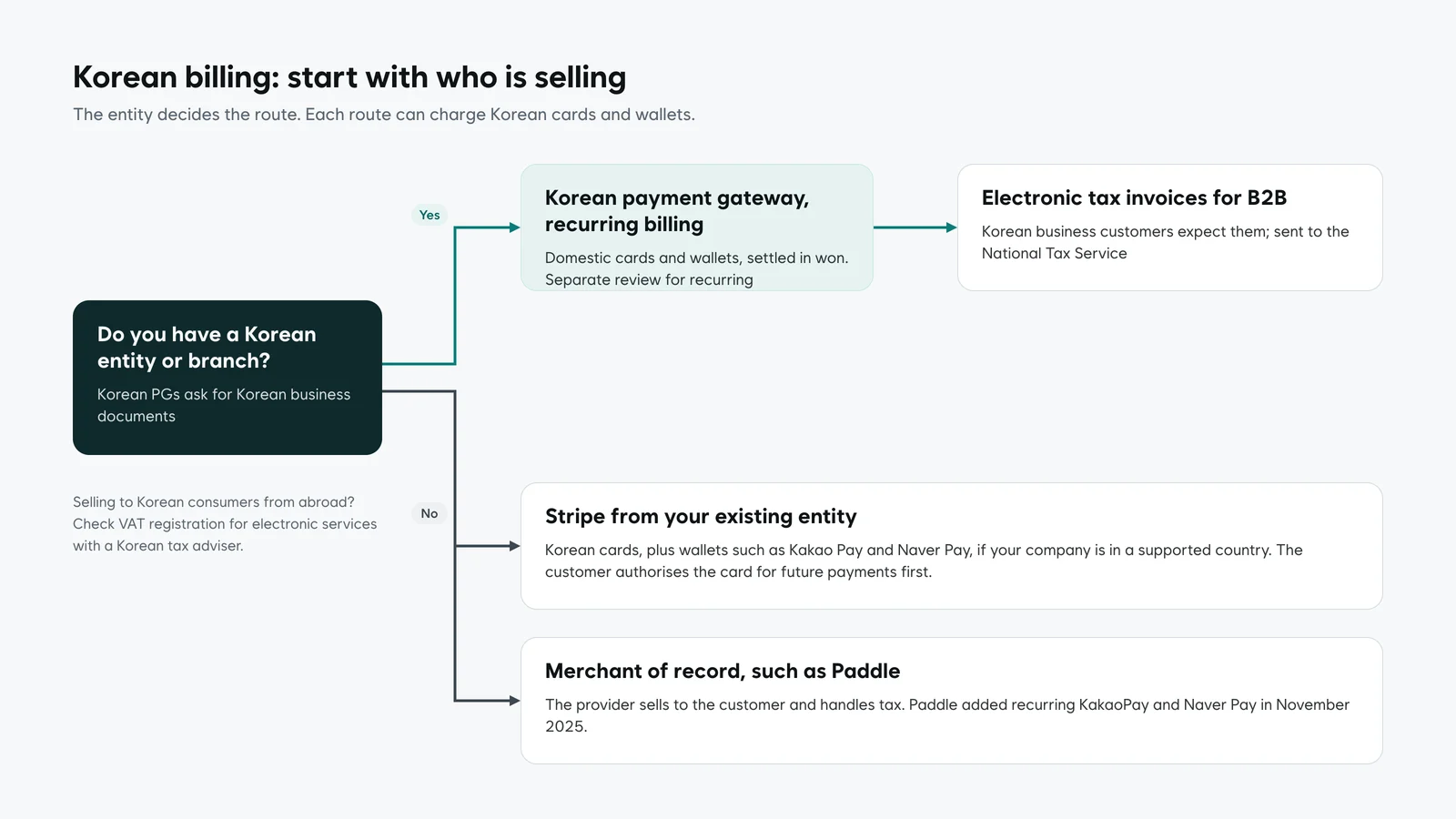
Korean business customers also expect a tax invoice (세금계산서) for what they buy. If your Korean entity sells to them, that means electronic tax invoices sent to the National Tax Service; our guide to Korean e-tax invoices covers the options. Plan this before the first enterprise deal, because finance teams often ask for it before they approve a purchase.
Does a foreign SaaS company owe Korean VAT?
It can. Since 2015, foreign businesses that provide electronic services, which includes software and cloud services, to Korean consumers may have to register for VAT in Korea, file quarterly returns and pay VAT through Hometax. Advisers note that Korea sets no minimum revenue threshold for this, and that sales to Korean businesses for business use are generally excluded. A merchant of record usually takes this on for you; if you sell directly, confirm your position with a Korean tax adviser before launch. This is general information, not tax advice.
What do notifications and support look like in Korea?
Korean users expect transactional messages, such as payment receipts, trial reminders and security alerts, to arrive in KakaoTalk. Businesses send these as AlimTalk messages from approved templates through an official dealer, with SMS as the fallback. Support chat usually runs through a KakaoTalk Channel linked from the help pages and the product.
Marketing is stricter than transactional messaging. Article 50 of the Network Act requires prior consent before sending advertising by email, text or messenger, messages at night need separate consent, and every advertising message needs an easy way to opt out. In the product, that means an unticked marketing consent box on sign-up, a record of when consent was given, and a one-step unsubscribe.
What does a Korean privacy policy have to cover?
Korea's Personal Information Protection Act (PIPA) requires a published privacy policy (Article 30) that covers, among other things, what you collect and why, how long you keep it, who you share it with or entrust processing to, and how users exercise their rights. If your servers, analytics or support tools are outside Korea, the rules on overseas transfers (Article 28-8) also apply. In the sign-up flow, consent items are usually shown separately rather than bundled into one checkbox. Have a Korean lawyer review the final text; it is not something to translate from your global policy. If you are still choosing where to host, hosting a website for Korean users covers server location and data questions together.
What is a sensible launch order?
- Korean marketing pages and a way to contact you in Korean. A Korean landing page or section, a Korean inquiry form and a KakaoTalk Channel. This tests demand cheaply.
- Korean interface and billing. Translate the product, fix formats and line breaks, and turn on a payment route that Korean customers can actually use.
- Notifications and sign-in. AlimTalk for receipts and reminders, then Kakao or Naver login if your sign-up data shows Korean users dropping out at registration.
- Operations for head office. Reporting, refunds and support views your global team can read in English, with Korean data underneath.
What does it cost to add the Korean pieces?
These are our catalogue prices for modules in a product we build (pricing catalogue version 1.1, 23 September 2026), in US dollars, excluding VAT. Work inside an existing codebase is quoted after we have read it.
| Module | Range (USD, excl. VAT) | Third-party costs |
|---|---|---|
| A second language (each further language USD 150–300) | 200–550 | — |
| Social login, such as Kakao or Naver | 200–550 | — |
| Phone identity verification | 450–850 | Verification provider fees |
| One-time payments | 550–1,300 | Payment fees |
| Recurring (subscription) payments | 1,400–2,900 | Payment fees |
| AlimTalk and SMS notifications | 200–550 | Sending fees |
| A new web app with sign-in, core flows and admin | 1,800–3,900 over 6–12 weeks | Hosting |
How we work with SaaS teams outside Korea
We are a two-person studio in Korea; our CEO and a director design and build every project themselves. Our English-speaking founder runs consultations, meetings and documents directly. We can meet your team in person in Korea, and we bill in USD or by overseas transfer if you prefer.
On the Korean side, we prepare the applications and handle the Korean-language communication for payment gateways, the KakaoTalk Channel and Naver Search Advisor, while your company stays the contracting party. Our own client portal bills maintenance with recurring card payments through a Korean payment service, so we have run Korean recurring billing in production, not only in a sandbox. For a broader view of how projects are contracted, read outsourcing software development to South Korea.
Frequently asked questions
Do I need a Korean entity to sell SaaS in Korea?
Not to start. Stripe from a supported country or a merchant of record can charge Korean cards and wallets. A domestic Korean payment gateway, Korean e-tax invoices and won settlement in Korea generally need a Korean entity. Tax registration is a separate question for your adviser.
Can Korean customers pay for a subscription through Stripe?
Stripe documents subscriptions with South Korean cards, and the customer first authorises the card for future payments. Check Stripe's current documentation for which Korean wallets support recurring charges on your account.
Do Korean business customers need tax invoices?
Korean companies expect a tax invoice for business purchases. If your Korean entity sells to them, it issues electronic tax invoices that are sent to the National Tax Service. Our e-tax invoice guide covers issuing options.
Should the Korean interface be formal?
Korean product copy is usually polite and fairly formal. What matters most is consistency: buttons, errors, emails and help pages should use the same level of politeness.
Do Korean users need Kakao or Naver login?
Email sign-up works. Kakao Login and Naver Login are common options that many Korean users prefer. Add them if your sign-up data shows Korean users leaving at registration.
Sources
All checked October 2026.
- Stripe, Set up a subscription with South Korean cards
- Paddle, Recurring KakaoPay and Naver Pay subscriptions (19 November 2025)
- Forvis Mazars Korea, Korean VAT for foreign AI and SaaS businesses (10 August 2026)
- Korea Ministry of Government Legislation, Act on Promotion of Information and Communications Network Utilization and Information Protection (Article 50)
- Korea Ministry of Government Legislation, Personal Information Protection Act (Articles 28-8 and 30)
- NQ Solution pricing catalogue v1.1 (23 September 2026), in USD excluding VAT
Planning your Korean launch?
Send us your product, your billing setup and the Korean features you need through the project request form. For the wider picture, start from the Korea market entry overview or see the integrations we build for Korea.