

Hosting for Korean Users: Seoul vs US vs EU Speed
We measured from Korea: first byte in about 40 ms from AWS Seoul, 0.8 s from US East, 1.1 s from Frankfurt. Where to host, CDNs, .kr and data location.
If most of your visitors are in Korea, serve the site from a cloud region in Seoul, or at least put a CDN with Seoul locations in front of it. In our own test from a Korean connection, the first byte of an HTTPS request came back in about 40 ms from AWS Seoul, about 0.8 seconds from US East and about 1.1 seconds from Frankfurt. A CDN hides most of that for images and scripts, but not for pages and API calls that have to reach your server.
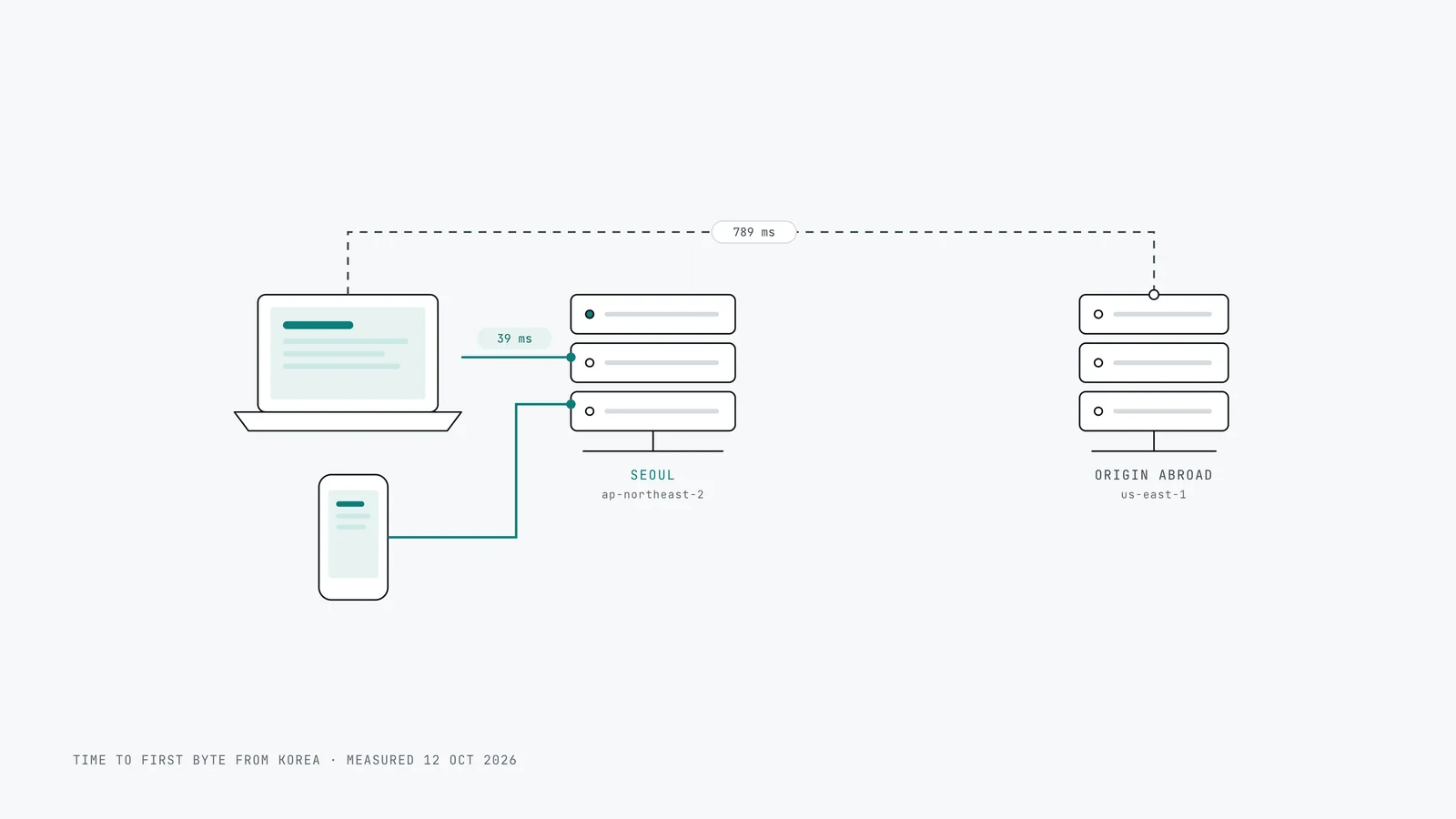
This guide covers what server location changes for Korean visitors, which setups work, where the Korean cloud regions are, and the domain, crawler and data questions that come with hosting for Korea.
Does server location matter for Korean visitors?
Yes, for anything that is not cached. Every new HTTPS connection needs a few round trips before the first byte arrives, and each round trip to Europe or the US east coast takes a large fraction of a second from Korea.
We measured it on 12 October 2026 from an ordinary office connection in Korea. For each AWS region we opened 18 fresh HTTPS connections to the region's public EC2 endpoint and took the median of each timing.
| Origin region | TCP connected | TLS ready | First byte |
|---|---|---|---|
| Seoul (ap-northeast-2) | 10 ms | 30 ms | 39 ms |
| Tokyo (ap-northeast-1) | 57 ms | 149 ms | 195 ms |
| Singapore (ap-southeast-1) | 76 ms | 228 ms | 303 ms |
| Oregon (us-west-2) | 147 ms | 436 ms | 578 ms |
| N. Virginia (us-east-1) | 199 ms | 592 ms | 789 ms |
| Frankfurt (eu-central-1) | 279 ms | 835 ms | 1,113 ms |
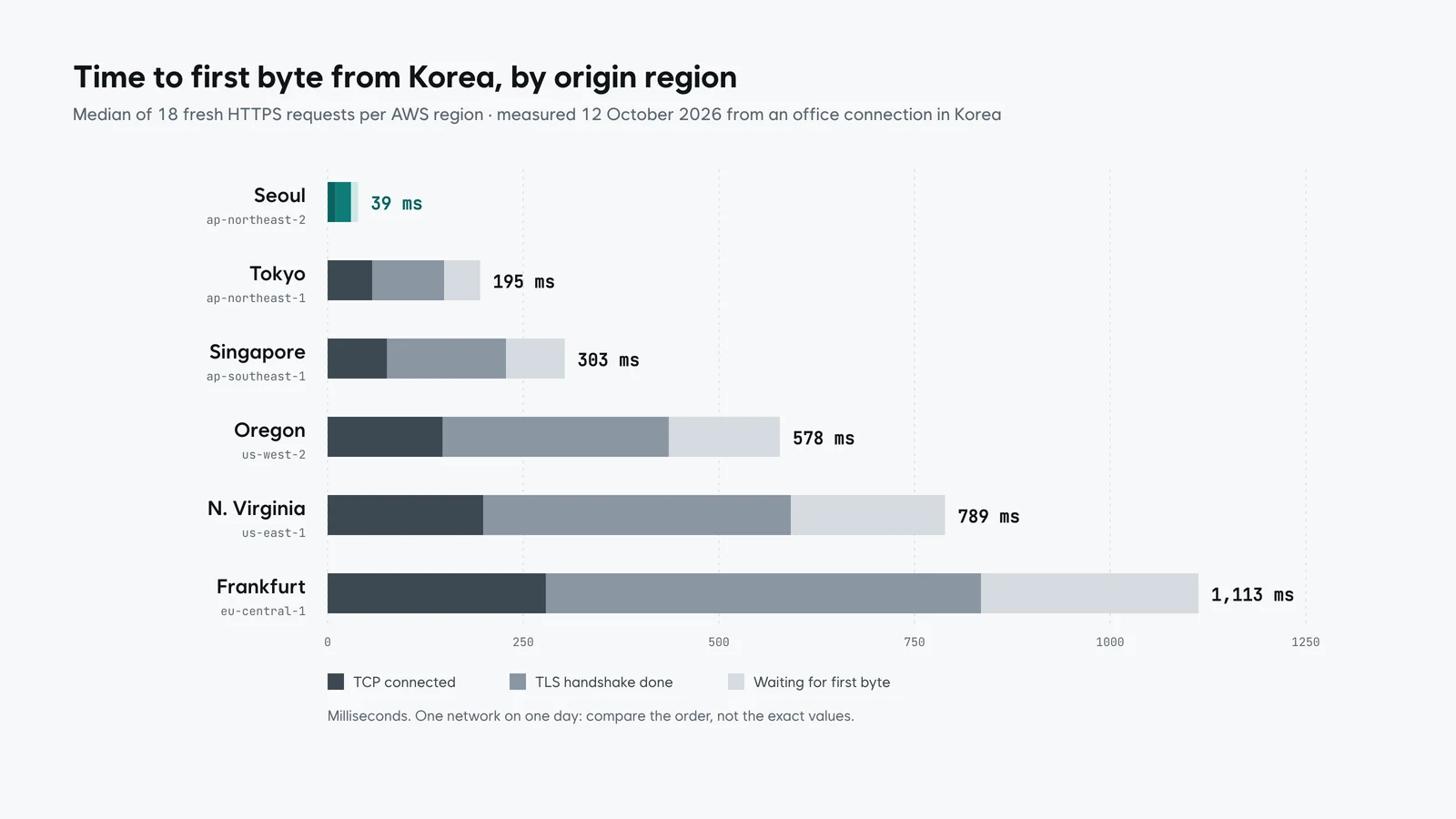
Treat these as one measurement, not a benchmark. A different network, time of day or mobile connection will give different numbers, and browsers reuse connections once they are open. What does not change is the order: the further the origin, the longer every uncached request waits.
The delay matters most where caching cannot help:
- The HTML of server-rendered pages, including product and article pages that change often.
- Search, filters and forms that call your API.
- Sign-in and checkout, where Kakao Login, Naver Login or a Korean payment gateway redirect the user back to your server, sometimes several times.
- Logged-in dashboards and admin screens, which are rarely cached at all.
Which setup should you choose?
There are four common setups. The right one depends on how much of the site is dynamic and where the rest of your users are.
| Setup | How it works | Fits when | Watch out for |
|---|---|---|---|
| Keep your origin, add a CDN | Your existing server stays where it is; a CDN with Seoul locations caches images, scripts and static pages | A mostly static marketing site, or Korea is a small share of traffic | HTML, API calls and sign-in still travel to the origin |
| Move the origin to Seoul | Server and database run in a Seoul cloud region | Korea is the main market, or the site is a web app | Users elsewhere now have the long trip |
| Split static and dynamic | Static assets on a CDN, the Korean app or API in a Seoul region | A global product with a Korean version that has its own users | Two deployments and two sets of monitoring to run |
| A Korean hosting platform | A Korean cloud or hosting company runs the server | A Korea-only site with a Korean operator | Check the admin language and support language your team needs |
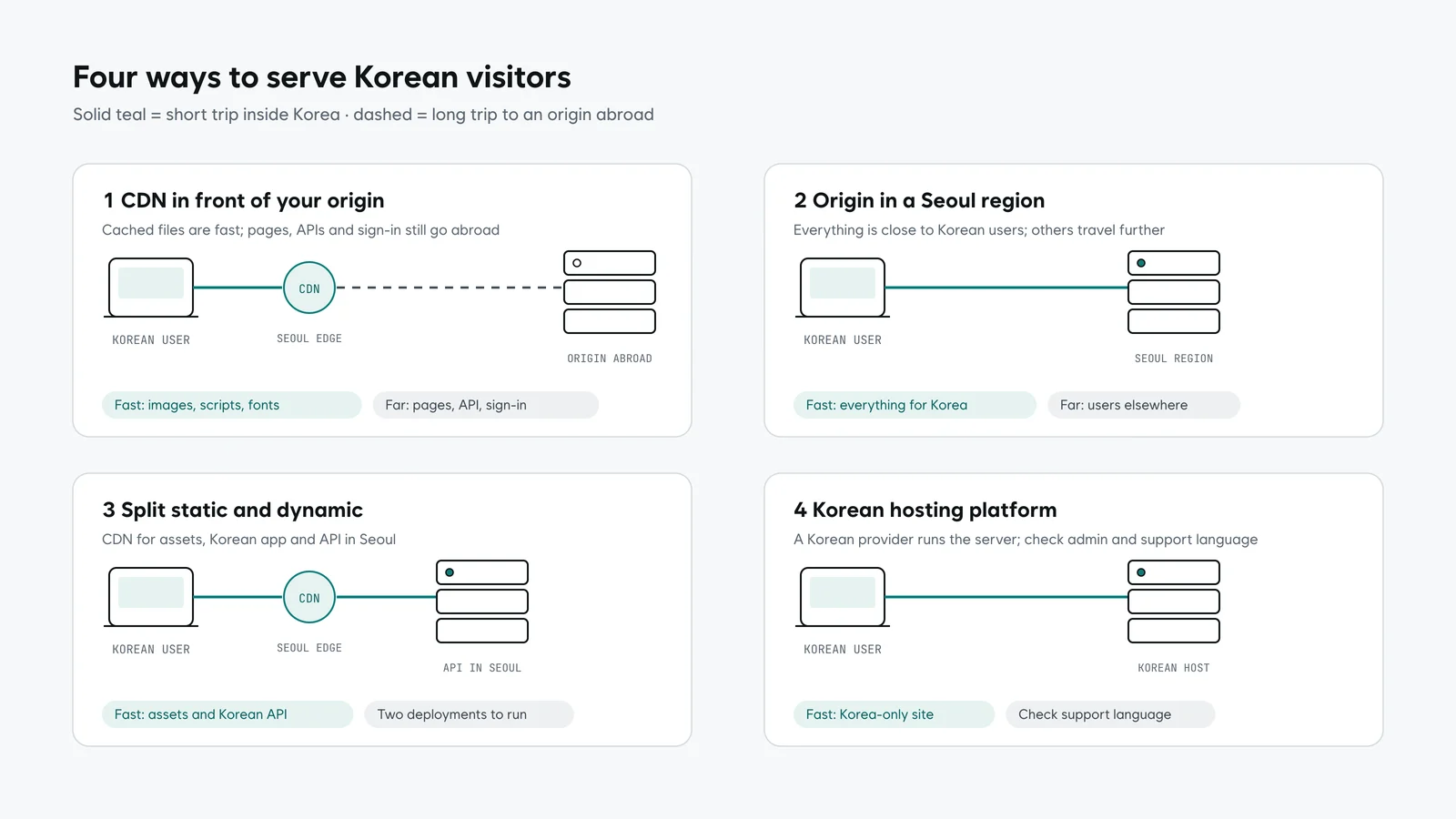
For a Korean marketing site attached to a global product, the first option is often enough. Once Korean users sign in, pay or work in the product every day, the server and database should be close to them.
Which cloud regions are in Korea?
The large providers all have a Seoul presence:
- AWS opened its Asia Pacific (Seoul) region, ap-northeast-2, in 2016.
- Google Cloud opened asia-northeast3 in Seoul in February 2020, with three zones from the start.
- Vercel lists icn1 (Seoul) as a compute region and maps it to AWS ap-northeast-2.
- CDNs: Amazon CloudFront has had edge locations in Seoul since 2015, and Cloudflare has run a data centre in Seoul since 2012.
Check two things before you rely on a CDN or edge platform. First, that your plan actually serves Korean traffic from Seoul: routing depends on the provider's agreements with Korean networks, and users on Vercel's community forum have reported Korean traffic reaching a Japanese region instead of Seoul. Second, that functions, middleware and the database sit in the same region; a Seoul function that queries a database in the US is still a US round trip.
Why do Korean pages need lighter fonts?
Korean text needs a Korean font, and Korean fonts are large because they cover thousands of Hangul syllables (Unicode has 11,172 precomposed syllables). The complete variable version of the Korean typeface this site uses is about 1.3 MB as a single file.
On a fast origin that is a nuisance; on a slow one it delays every first visit. Serve fonts from the same CDN as the rest of your assets, use a split or subset version of the font so the browser loads only the ranges a page needs, and set font-display: swap so text appears before the font finishes. Our Korean web design guide covers the typography side.
Should you use a .kr domain?
Only if you have a presence in Korea. KRNIC, which runs the .kr registry, states that registrants must have a local presence in Korea, and registration goes through accredited registrars rather than KRNIC directly. Most foreign companies serve the Korean site from a /ko/ subfolder of their existing domain, which also keeps the domain's search history. Hosting location is a separate decision: a subfolder can still be served from a Seoul region through your CDN or a reverse proxy. Do you need a Korean website? compares the options.
Can Naver reach your server?
A fast Seoul server does not help if Naver's crawler is blocked. Firewalls, bot-protection rules and some CDN settings challenge or block crawlers they do not recognise, and Naver's crawler, Yeti, is less familiar to tools configured with Google and Bing in mind. After moving hosting or adding a CDN, check your robots.txt and firewall logs and run the checks in Naver Search Advisor. The steps are in Naver SEO for foreign websites.
Where should Korean users' data live?
If the site collects personal information from Korean users, such as inquiry forms, accounts or orders, hosting outside Korea means that information is stored or processed abroad. Korea's Personal Information Protection Act has rules on transferring personal information overseas (Article 28-8), and the privacy policy has to describe how information is handled (Article 30). Hosting in Seoul does not remove these duties, because email, analytics and support tools may still send data abroad. Ask your Korean adviser which disclosures and consents apply to your setup, and list every service that touches the data before launch. This is general information, not legal advice.
How do you test speed from Korea?
Test from a Korean connection, not from a monitoring server in your own country. Simple ways to do it:
- Ask a colleague or partner in Korea to open the site on mobile data and on office Wi-Fi, with the browser's network panel open.
- Run a timing request from a machine in Korea, for example
curl -w "%{time_starttransfer}\n" -o /dev/null -s https://example.com/ko/, several times and compare the median with your current numbers. - Test the slow paths, not just the home page: sign-in, search, checkout and the first page after login.
How we set up hosting for Korean sites
We deploy the sites we build, including SSL and connecting your domain, and we pick the hosting region with you based on where your users are. This site, for example, runs on a cloud platform with servers in Korea. Hosting and maintenance after launch are a separate contract from the build, with their own terms.
If you already run a global site and are adding a Korean version, we usually start by measuring the Korean paths that matter (pages, sign-in, checkout) and then decide whether a CDN is enough or the Korean part needs its own server in Seoul. Our web development in Korea page explains how we build and hand over sites.
Frequently asked questions
Do I need to host my website in Korea?
Not always. A mostly static marketing site can stay on its current server with a CDN that has Seoul locations in front of it. If Korean users sign in, search, pay or use a dashboard, host the server and database in a Seoul region, because those requests cannot be cached and each one makes the long trip.
Is a CDN enough for Korean visitors?
A CDN is enough for images, scripts, fonts and pages you can cache. It does not speed up requests that must reach your origin, such as API calls, sign-in, checkout and logged-in pages. In our test from Korea, a fresh request to a US East origin took about 0.8 seconds to the first byte, against about 40 ms for Seoul.
Which AWS region is in Korea?
AWS Asia Pacific (Seoul), code ap-northeast-2, opened in 2016. Google Cloud's Seoul region is asia-northeast3, and Vercel's Seoul compute region is icn1, which runs on AWS ap-northeast-2.
Can a foreign company register a .kr domain?
KRNIC, the .kr registry, states that registrants must have a local presence in Korea, and registration goes through accredited registrars. Without a Korean entity or address, a /ko/ subfolder on your existing domain is the usual choice.
Does hosting abroad hurt Naver SEO?
What matters most is that Naver's crawler, Yeti, can reach and read your pages, so check firewalls, bot protection and robots.txt. Slow responses do make the site worse for Korean visitors, so hosting closer to them helps the people who arrive from search as well.
Sources
All checked October 2026.
- NQ Solution, latency measurement from a Korean connection to AWS regional endpoints, 12 October 2026 (18 requests per region, medians)
- Amazon Web Services, Now open: AWS Asia Pacific (Seoul) region and CloudFront and Route 53 locations in Seoul
- Google Cloud, New GCP region in Seoul
- Vercel, Regions and a community thread on Korean traffic routing
- Cloudflare, Seoul, Korea: Cloudflare's 23rd data center
- KISA KRNIC, .kr domain FAQ
- Korea Ministry of Government Legislation, Personal Information Protection Act (Articles 28-8 and 30)
Planning a Korean site or product?
Tell us where your users are and what the site has to do through the project request form, and we will propose a hosting setup with the build. For the wider picture, start with the Korea market entry overview.