
Korean or Global Agency for Your Korea Launch?
Most foreign companies split it: the global agency keeps brand and codebase, a Korean team builds payments, KakaoTalk and Naver. How to divide the work.
For most foreign companies, the answer is to split the work. Your global agency keeps the brand, the design system and the main codebase; a Korean team builds the parts that depend on Korean providers, Korean documents and Korean review processes, such as payments, KakaoTalk, Naver and the Korean content setup. Hand everything to a Korean agency when Korea gets its own site or product, and keep everything with your global agency only when the Korean version is a set of translated pages.
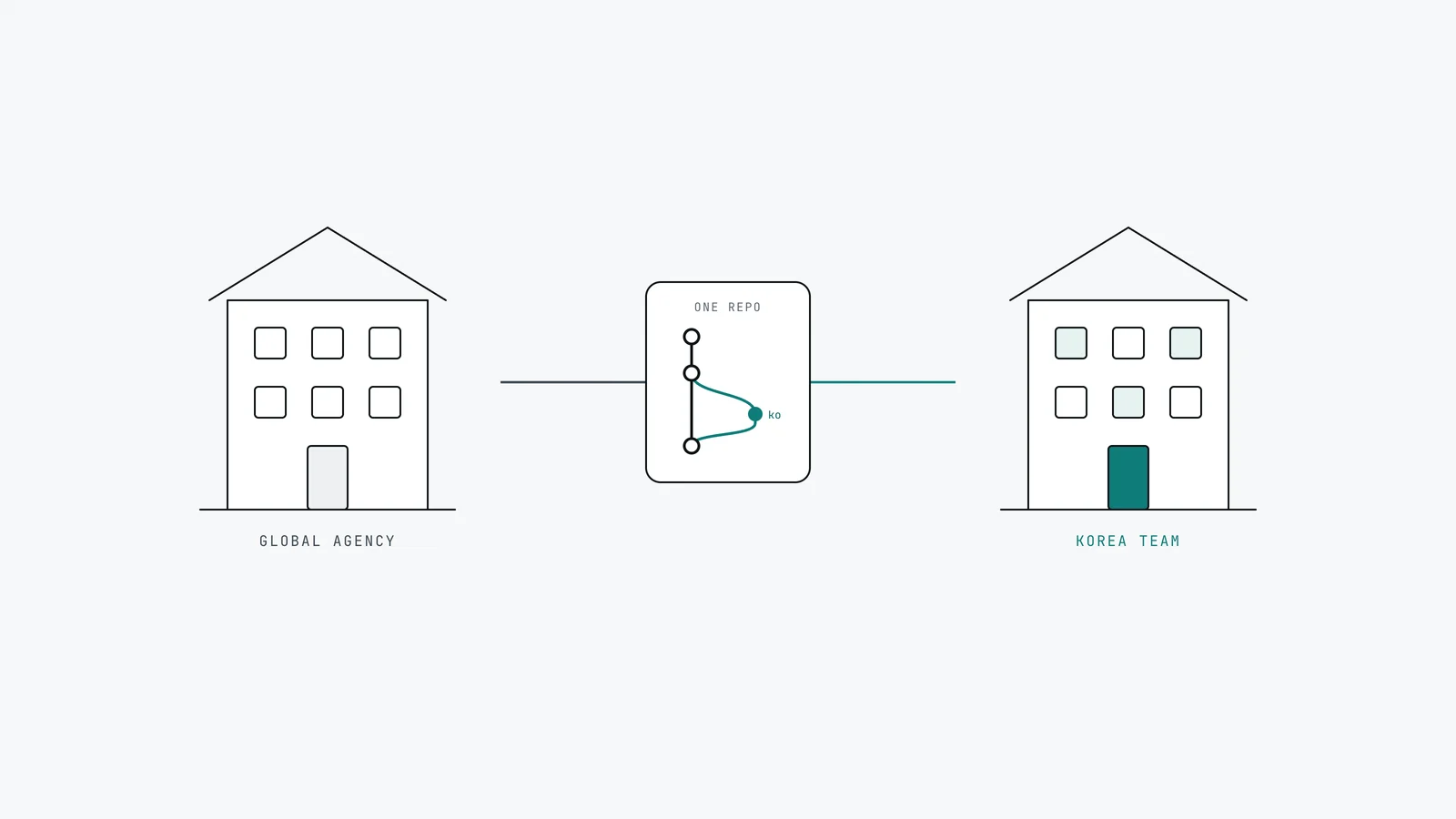
This guide shows how to decide, which parts belong to which team, what the global agency should hand over and how two agencies can share one product without getting in each other's way.
What are the options for building the Korean version?
| Option | Who builds what | Fits when | Main risk |
|---|---|---|---|
| Global agency only | Your current agency adds Korean pages and translations | Korea is a translated marketing section with an inquiry form | Korean integrations, Korean review processes and Naver are new to the team, so they take longer and are easier to get wrong |
| Korean agency only | A Korean team designs and builds a separate Korean site or product | Korea has its own entity, brand, catalogue or product | Brand and code drift away from the global version over time |
| Split | The global agency owns brand, design system and core code; a Korean team builds and runs the Korea-specific parts | A global product or site with a Korean version that takes payments, sign-ups or Korean inquiries | Needs clear ownership, or both teams change the same files |
The deciding question is how much of the Korean version depends on Korea-only services. A page of Korean text depends on nothing. A Korean checkout depends on a payment gateway contract, card company review and Korean-language support from the provider.
Which parts need someone who works in Korean?
These are the parts where the provider's documentation, application forms and support are mainly in Korean, or where the review is done by a Korean organisation.
| Part | Why it is Korea-specific | Usual owner in a split |
|---|---|---|
| Brand, design system, global components | Shared across every market | Global agency |
| Korean copy and typography | Needs fluent review and Korean font handling | Your Korean team or a translator, with the Korean developers |
| Korean payments | PG contracts, card company review and test keys are handled in Korean | Korean team |
| KakaoTalk Channel and AlimTalk | Channel setup and template review by Kakao and its dealers | Korean team |
| Kakao and Naver login | Developer console settings and Naver's app review | Korean team |
| Address search and phone verification | Korean APIs and provider contracts | Korean team |
| Naver Search Advisor | Site verification, sitemap and crawler checks | Korean team |
| Business information footer and Korean policies | Korean law decides what is shown; your lawyer approves the wording | Korean team builds, your adviser decides |
| Hosting, deploy pipeline, monitoring | One owner per environment | Whoever owns the main codebase |
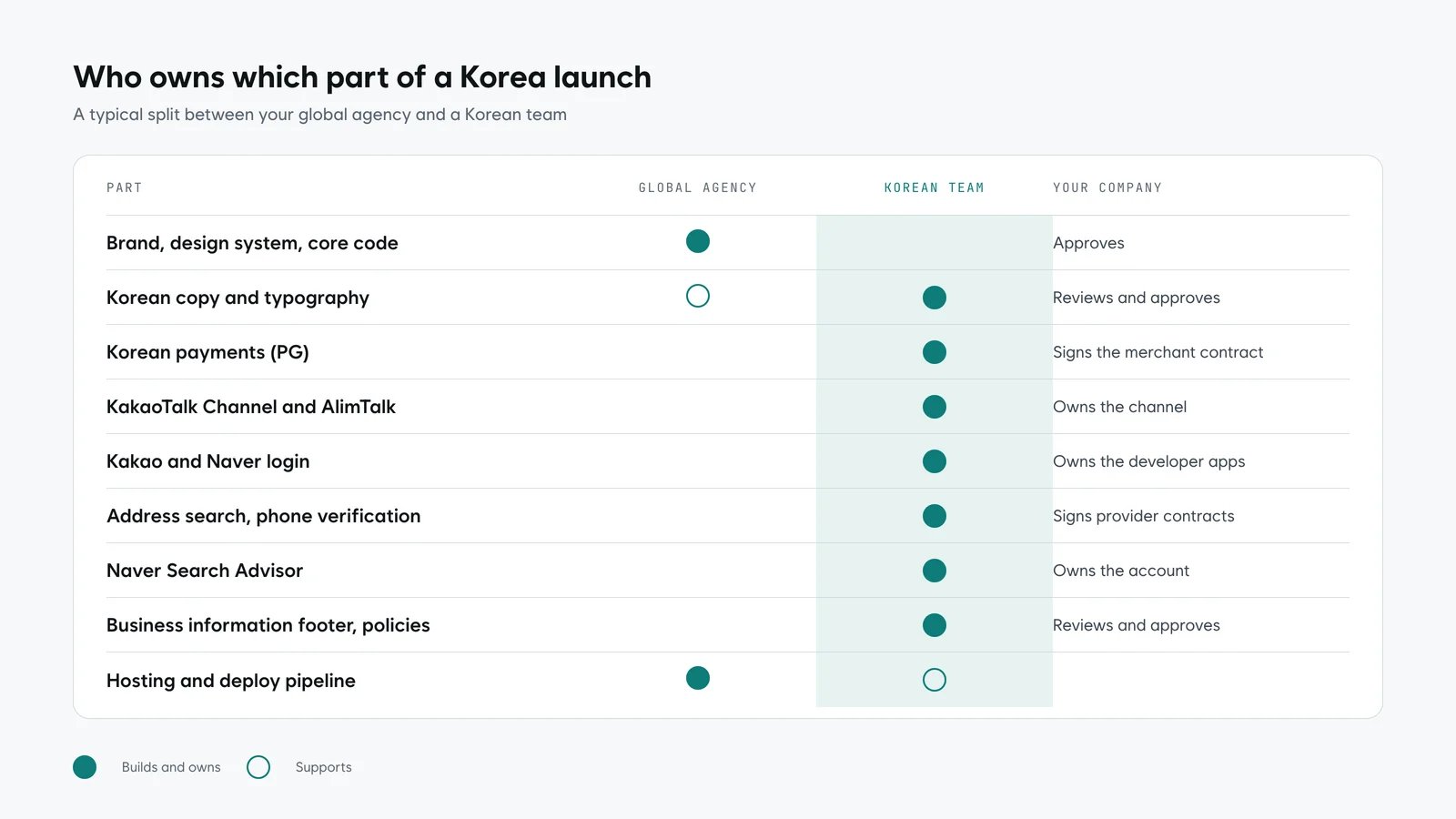
One rule holds in every option: your company signs the contracts with Korean providers. The payment gateway contract, the KakaoTalk Channel and the Naver Search Advisor account should belong to your company, not to either agency, so you can change agencies later without moving merchant contracts.
What should the global agency hand over?
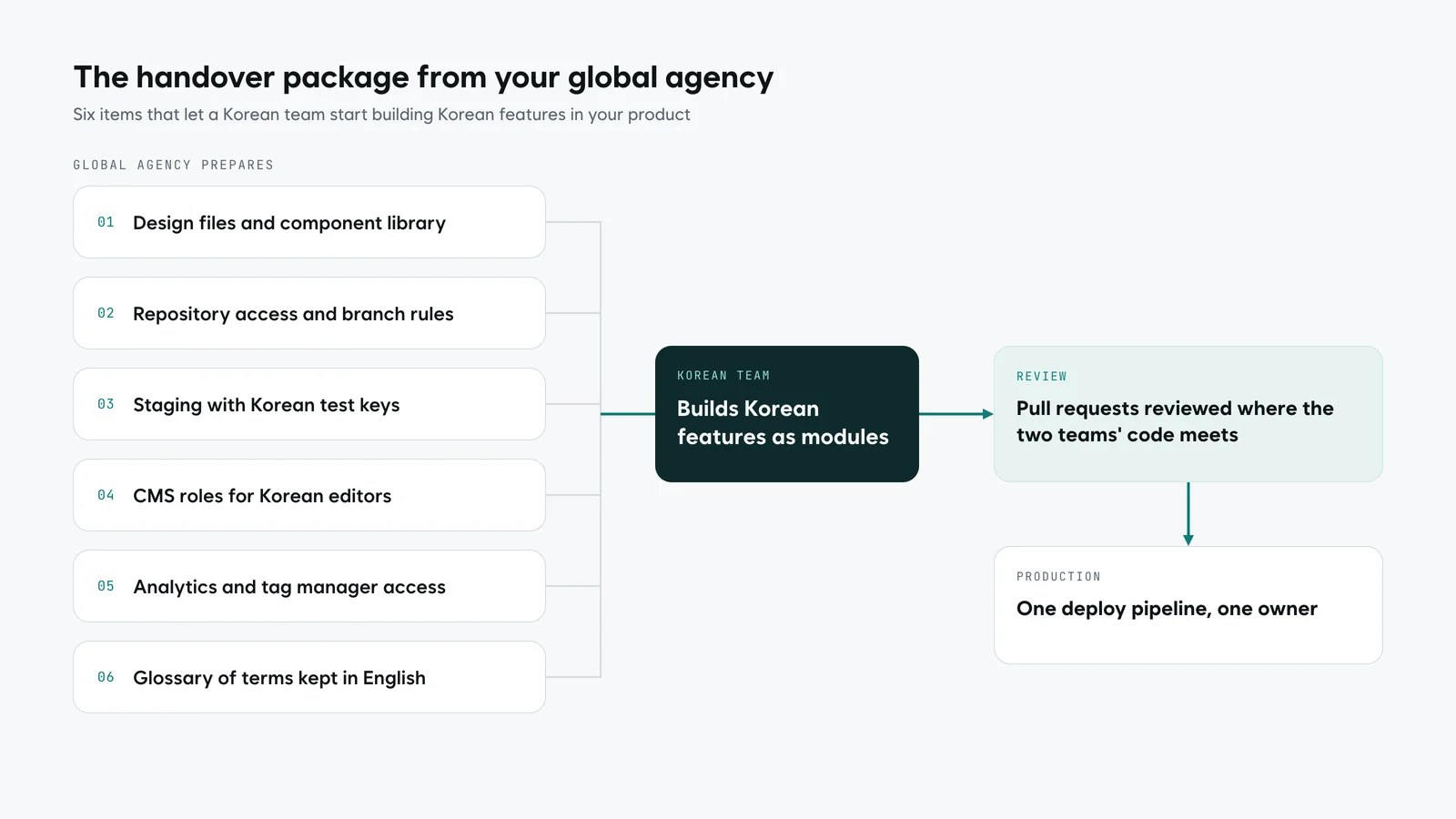
The Korean team can start quickly if the global agency prepares a short handover package:
- Design files and the component library, with the tokens for colour, spacing and type, so Korean screens use the same parts.
- Repository access with branch rules: who reviews pull requests in which folders, and how code reaches production.
- A staging environment where Korean features can be tested with Korean test keys.
- CMS roles so Korean editors can edit Korean pages without touching the global ones.
- Analytics and tag manager access, so Korean pages and events are tracked in the same property.
- A short glossary: product names, feature names and terms that stay in English in the Korean interface.
How can two agencies share one codebase?
It works when the boundaries are written down before anyone writes code:
- Separate the Korean features into modules. Korean payments, Kakao login and AlimTalk live in their own folders or packages, switched on for the Korean locale or by feature flag.
- Agree on owners for shared files. Layouts, routing and the design system belong to the global agency; the Korean team proposes changes there through pull requests.
- Keep one deploy pipeline. Two teams deploying the same app in two ways is how releases break. One team owns the pipeline; the other uses it.
- Keep secrets in your company's accounts. Payment keys and API keys sit in your cloud or secrets manager, with access for whichever team needs it.
- Test in Korean. Each release is checked with Korean text, Korean cards in test mode and a Korean phone number where the flow needs one.
If the Korean version is a separate site, most of this falls away, and the main shared asset becomes the brand guide.
What should you ask a Korean agency before hiring?
Beyond the usual checks on past work and contracts, which we cover in outsourcing software development to South Korea, ask questions specific to a split project:
- Who will be our English-speaking contact, and will that person also do the technical work?
- Can you work in our existing stack and follow our review rules?
- Will you prepare the Korean applications for the payment gateway, KakaoTalk Channel and Naver Search Advisor, and who signs them?
- How do you bill a company outside Korea?
- What do you hand back if we change agencies: code, documentation, accounts?
How we work as the Korean team
We are a two-person studio in Korea; our CEO and a director design and build each project themselves. Our English-speaking founder handles consultations, meetings and documents directly, without an interpreter. We can meet your team or your Korean staff in person in Korea, and we bill in USD or by overseas transfer.
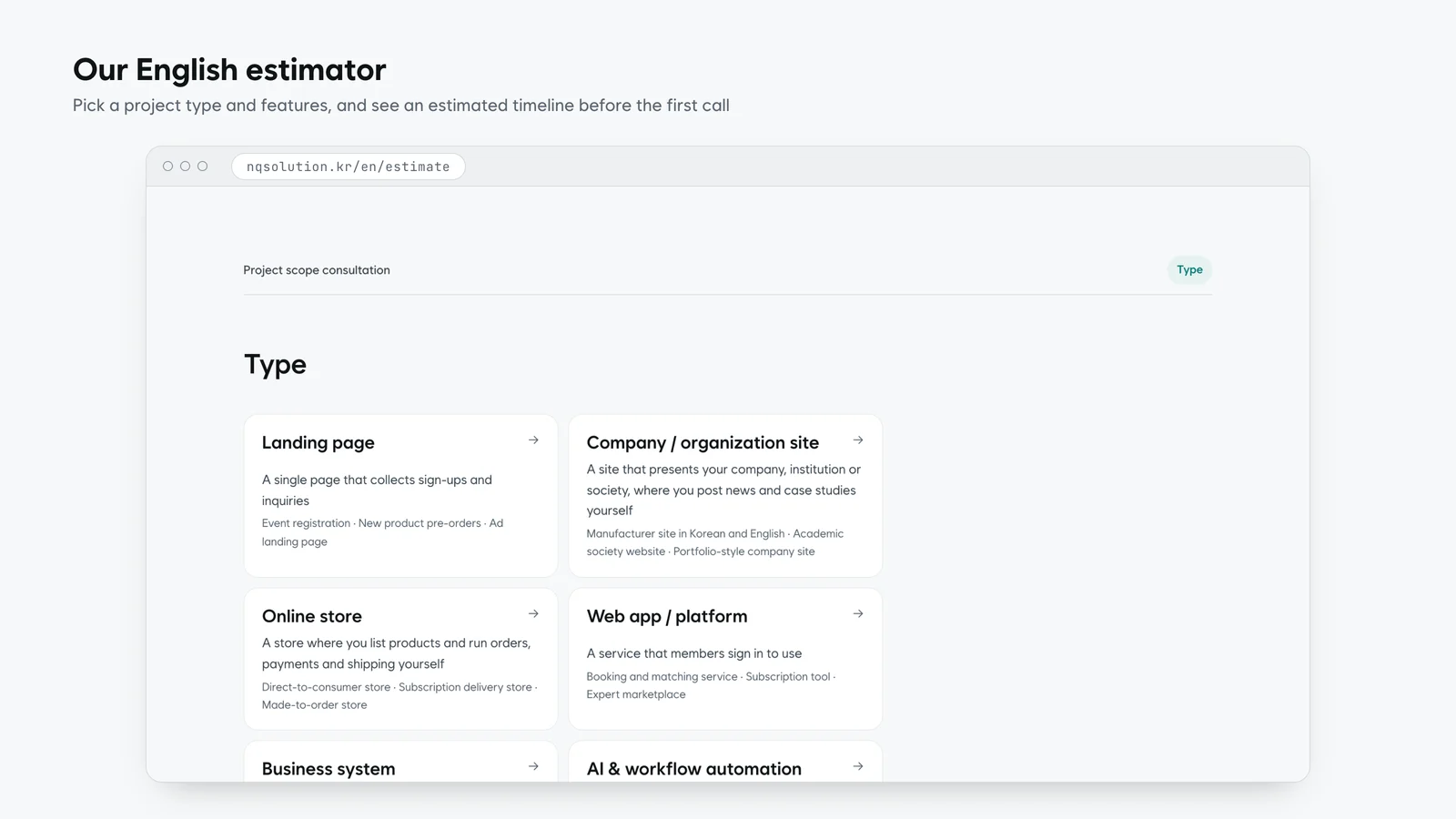
On the Korean side, we prepare the applications and handle the Korean-language communication for payment gateways, the KakaoTalk Channel and Naver Search Advisor, while your company remains the contracting party. We build mostly with Next.js, React and TypeScript, and use other stacks when a project needs them. Our English estimator lets your team outline the scope feature by feature and see an estimated timeline before a first call.
Frequently asked questions
Should I use a Korean agency or my global agency for the Korean site?
If the Korean version is translated pages with an inquiry form, your global agency can handle it with a fluent reviewer. If it takes Korean payments, uses KakaoTalk or Kakao and Naver login, or needs Naver registration, bring in a Korean team for those parts. If Korea has its own entity, brand or product, a Korean agency can build the whole thing.
Can a Korean development agency work in English?
Some can. Ask who your day-to-day contact will be and whether that person also builds the product. At our studio, our English-speaking founder runs consultations, meetings and documents directly.
Who should own the payment gateway and KakaoTalk accounts?
Your company. The merchant contract, the KakaoTalk Channel and the Naver Search Advisor account should be in your company's name, so you can change agencies without moving contracts. An agency can prepare the applications and handle the Korean-language communication.
How do two agencies avoid conflicts in one codebase?
Put Korean features in separate modules, agree who owns shared files such as layouts and the design system, keep one deploy pipeline and review each other's pull requests where the boundaries meet.
How do I pay a Korean agency from outside Korea?
Ask about currency and payment method before the quote is final. We bill in USD or by overseas transfer, with the build paid in instalments tied to checkpoints set in the contract.
Sources
- NQ Solution working terms for clients outside Korea (English consultations, in-person meetings in Korea, Korean-side setup support, USD or overseas transfer billing), confirmed in 2026
- NQ Solution English estimator, /en/estimate, screenshot taken in 2026
Looking for the Korean team?
Tell us what your global agency already owns and what the Korean version has to do through the project request form. See how we build Korean sites on the web development in Korea page, the Korean services we connect on Korea integrations, or start from the Korea market entry overview.