

Korean Subsidiary Reporting to Head Office
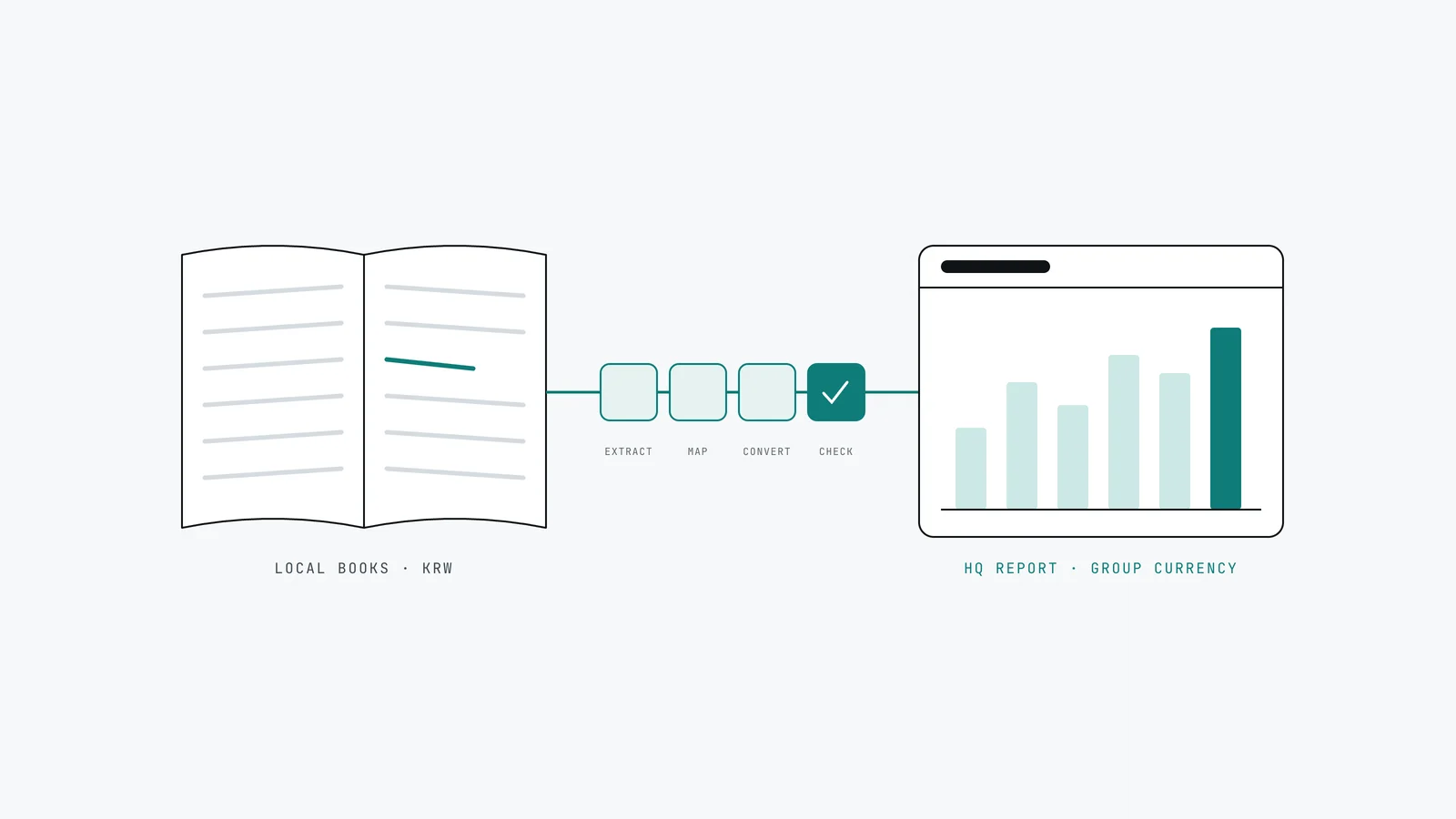
Don't replace the Korean books. Build a small bridge: export, map to group accounts, convert KRW, check, send an English pack. Automate step by step.
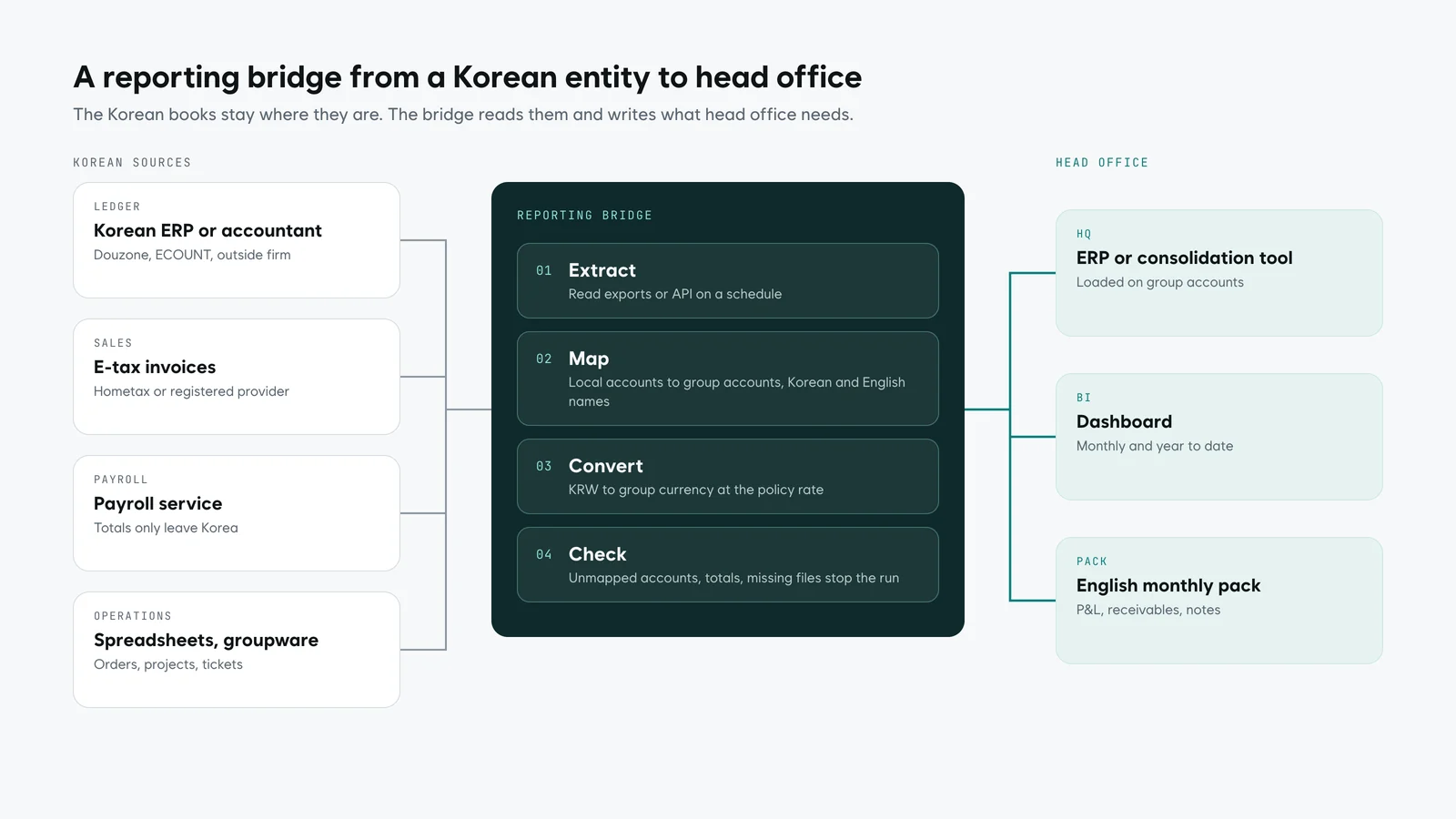
Most Korean subsidiaries keep their statutory books in a Korean accounting package or with an outside accounting firm, while head office wants the numbers in its own chart of accounts, currency and reporting calendar. The dependable fix is usually a small reporting bridge rather than a new ERP: export from the Korean side, map local accounts to group accounts, convert at the group's rate, check, and deliver an English pack or feed to head office. Automate it one step at a time, starting with the step that takes longest by hand.
This guide is for finance and IT teams at head office who need reliable monthly numbers from a Korean entity without disrupting the local accountant.
Where does a Korean subsidiary's data usually live?
Before designing anything, list where each kind of data sits today. In a small or mid-sized foreign-owned entity it often looks like this:
| Data | Typical home | Usual format |
|---|---|---|
| General ledger and statutory accounts | A Korean ERP or accounting package (Douzone Bizon and ECOUNT are widely used) or the outside accounting firm's system | Korean account names and codes; exports to Excel |
| Sales invoices to Korean customers | Electronic tax invoices issued through Hometax or a registered provider | Invoice records with Korean business registration numbers |
| Payroll | A payroll package or an outside payroll service | Payslips and payroll ledgers in Korean |
| Orders, projects, service tickets | Spreadsheets, groupware or a custom system | Whatever the team set up |
| Bank balances | Korean bank portals | Statements downloaded as files |
Most of the friction comes from the first and last columns: the books are correct, but they are in Korean, coded to a Korean chart of accounts and reachable mainly by export.
What makes Korean numbers hard to consolidate?
- Account names and codes. The local chart of accounts follows Korean practice and is labelled in Korean. Someone has to map every local account that carries a balance to a group account, and keep that map current when the accountant adds accounts.
- Currency. The won has no minor unit, so local amounts are whole numbers. Converting to the group currency needs an agreed rate source and date, usually set by group policy, and a rule for rounding differences.
- Names. Customers, suppliers and items are recorded in Korean. Head office reports need an English name next to the Korean one, not instead of it.
- Identifiers. Korean companies are identified by their ten-digit business registration number (for example, ours is 867-36-01532). It is a better key for matching customers and suppliers than a name, which may be written several ways.
- Calendar. Korea Standard Time is UTC+9 with no daylight saving, so a month-end cut-off in Seoul arrives before it does in Europe or the Americas. Agree whose midnight closes the month.
- Timing of local close. When an outside firm keeps the books, the closed ledger arrives when they finish, not when head office wants it. Build the reporting calendar around their schedule, or agree a soft close for management numbers.
How do you map local accounts to group accounts?
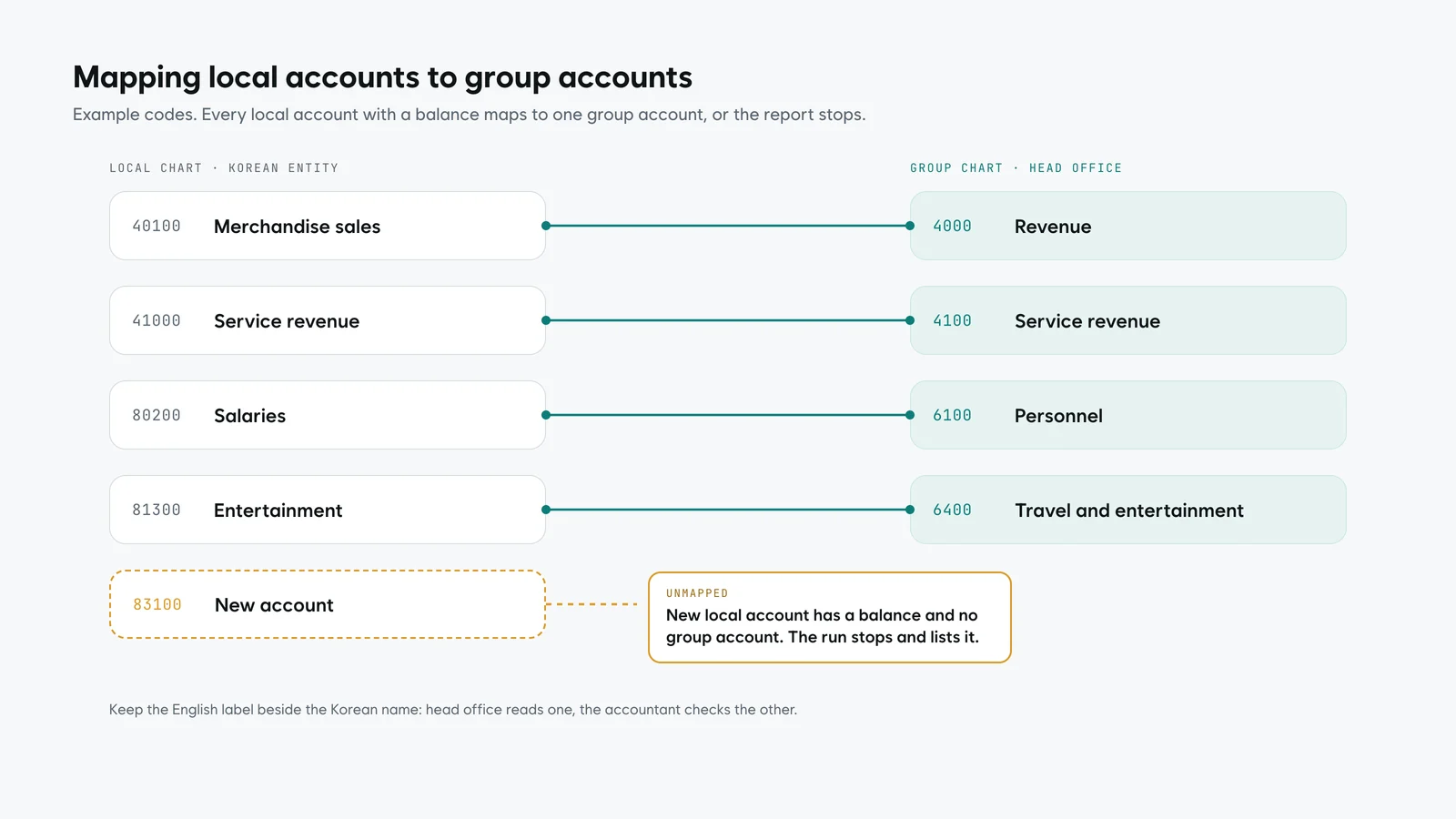
Keep the mapping as data, not as formulas scattered across a spreadsheet. A mapping table with one row per local account is enough:
| Local code | Local name (Korean) | English label | Group account | Notes |
|---|---|---|---|---|
| 40100 | 상품매출 | Merchandise sales | 4000 Revenue | |
| 41000 | 용역매출 | Service revenue | 4100 Service revenue | |
| 80200 | 직원급여 | Salaries | 6100 Personnel | Aggregate only |
| 81300 | 접대비 | Entertainment | 6400 Travel and entertainment |
The codes above are an example; use the codes from your subsidiary's actual chart. Three rules keep the map reliable:
- Every account with a balance must map. The bridge should refuse to produce a report if a new local account appears without a mapping, and list the missing ones.
- Keep the English label beside the Korean name. Head office reads the English; the accountant checks against the Korean.
- Version the map. When a mapping changes, record when and why, so last year's numbers can still be explained.
Which way should you build the bridge?
| Approach | How it works | Fits when | Watch out for |
|---|---|---|---|
| Structured template | The accountant exports to a fixed spreadsheet template; a script maps and converts it | A few reports a month, small team | Depends on the export layout staying the same |
| Scheduled export and import | Exports are dropped into a shared folder or upload screen; the bridge validates, maps and loads them into head office systems | Monthly close with several sources | Needs someone to watch for failed imports |
| API connection | The bridge reads from the Korean system's API on a schedule | The local system offers an API on your plan | Check API access, limits and who holds the key |
API availability varies by product and plan. ECOUNT, for example, offers an Open API at no extra fee, with documentation available after login; for other products, ask the vendor or your local partner what your licence includes before planning around it.
Whichever approach you choose, give the bridge a simple screen: upload or fetch status, validation errors in plain language, the mapping table, and a button to produce the head office pack. A bridge that only the person who wrote it can run is a spreadsheet with extra steps.
What should head office receive?
Agree the output before building anything. A typical monthly pack from a Korean entity contains:
- Profit and loss and balance sheet on group accounts, in the group currency, with the local-currency figures alongside.
- Receivables by customer, with Korean and English names and ageing.
- Headcount and personnel cost totals, not individual payroll lines.
- Variance notes written by the local team for the largest movements.
Keep personal data out of the pack. Individual salaries and employee details are personal information under Korea's Personal Information Protection Act, and sending them abroad brings in the Act's rules on overseas transfers (Article 28-8). Aggregates usually give head office what it needs. Ask your Korean adviser before any employee-level data leaves Korea. This is general information, not legal advice.
How do you roll it out without disrupting the accountant?
- Agree the calendar and the mapping with the local accountant and head office finance. This is a meeting and a spreadsheet, not software.
- Fix the export. Settle on one export layout from the Korean side and keep a sample file for testing.
- Automate validation and mapping. The bridge reads the export, checks it, maps it and shows what is missing.
- Automate delivery. Load into the head office system, or produce the English pack, from the same validated data.
- Add sources one at a time. Bank files, e-tax invoice records and operational data from spreadsheets come later, each with its own checks.
Nothing in this sequence asks the local accountant to change how they keep the books. That is usually what makes it last.
What does it cost?
A reporting bridge is small compared with an ERP rollout. In our pricing catalogue (version 1.1), these are the relevant line items, in US dollars, excluding VAT:
| Item | Range (USD, excl. VAT) |
|---|---|
| Discovery: mapping sources, outputs and the calendar | 200–550 |
| Base business system covering one workflow end to end (4–10 weeks) | 1,400–4,300 |
| Simple one-way API integration (each) | 200–450 |
| Two-way data sync (each) | 550–1,100 |
| Extended admin (three or more roles, Excel export, audit log) | 450–1,100 |
| Data migration from spreadsheets | 350–1,100 |
If the subsidiary also needs a system for its own work, such as quotes, orders or service tickets, the bridge can read from it directly. Our guide to ERP for foreign companies in Korea compares Korean packages, global ERP and custom systems, and custom ERP development cost in Korea has the full price breakdown.
How we build reporting systems for Korean entities
Our own studio runs on a system we built, where requests, quotes, contracts, schedules and maintenance sit on the same customer and project records, and grew one workflow at a time. We take the same approach with a Korean entity: start with the report that hurts most, keep the local books where they are, and add sources step by step.
Our English-speaking founder runs consultations and documents with head office, and we can meet the local finance team and accountant in person in Korea. See what we build on the ERP and business systems in Korea and software development in Korea pages.
Frequently asked questions
How do Korean subsidiaries usually report to headquarters?
Most keep statutory books in a Korean accounting package or with an outside accounting firm and send head office a monthly pack built from exports, often by hand in spreadsheets. A reporting bridge automates that: it reads the exports, maps local accounts to group accounts, converts currency and produces the pack or loads the head office system.
Should we replace the Korean ERP with our global ERP?
Not necessarily. Korean packages handle Korean tax and payroll and are kept current by their vendors. Many foreign-owned entities keep the local package for statutory work and add a bridge for group reporting. Replacing it makes more sense when the entity is large enough to justify a full global rollout with a Korean localisation partner.
Can Korean accounting software export to SAP, Oracle or NetSuite?
Korean packages export to files such as Excel, and some offer APIs depending on the product and plan. ECOUNT, for example, publishes an Open API. The bridge between them is usually built for your group's chart of accounts and format, because no two groups report the same way.
Which exchange rate should we use?
Use the rate source and date your group accounting policy specifies, and apply it in the bridge, not by hand. Record the rate with each report so the numbers can be reproduced later.
Can we send employee payroll data to head office?
Individual payroll data is personal information under Korean law, and transferring it abroad has its own rules. Monthly packs usually carry headcount and personnel cost totals instead. Ask a Korean adviser before sending employee-level data.
Sources
All checked in 2026.
- ECOUNT, ERP Open API
- Douzone Bizon, ERP solutions
- Korea Ministry of Government Legislation, Personal Information Protection Act (Article 28-8)
- NQ Solution pricing catalogue v1.1, in USD excluding VAT
Need cleaner numbers from your Korean entity?
Send us your current reporting pack, the Korean systems involved and what head office needs through the project request form. For the wider picture, start from the Korea market entry overview.